Oct 18, 2026
HVAC Installation Tools: What a Copper Line Set Job Actually Needs | Torchmark
The tools an HVAC installer uses on a copper line set job, step by step: cutting, deburring, bending, flaring and leak checks. Model-level guidance for distributors building an HVAC range.
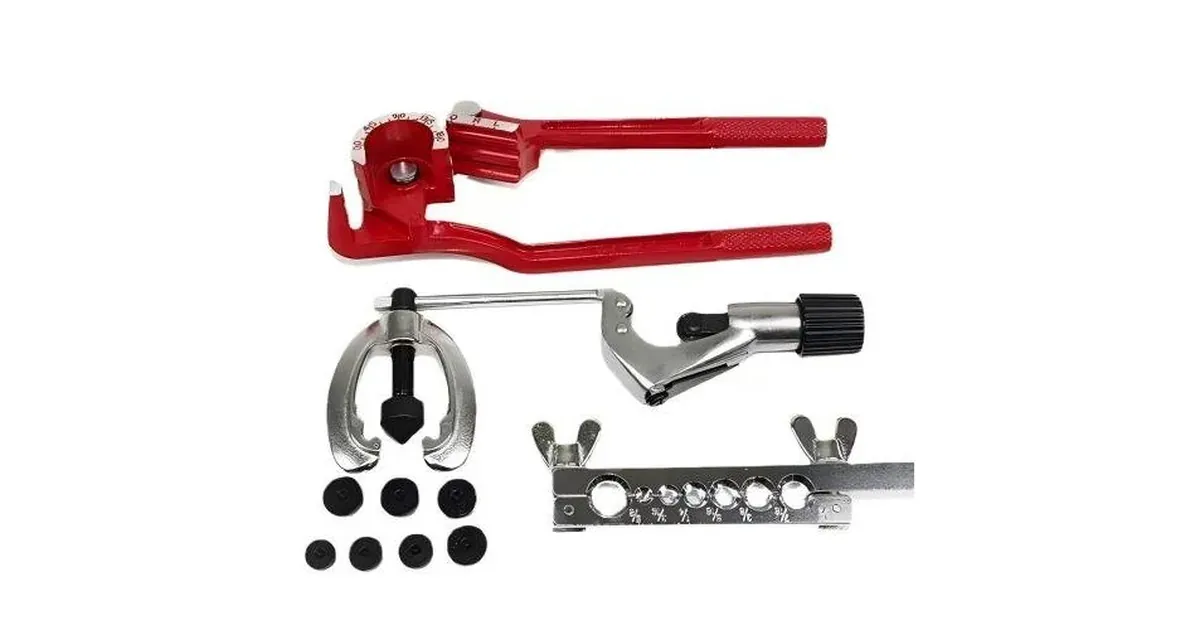
An HVAC installer does not buy "flaring tools". They buy the set of tools that gets a line set fitted, flared, pressure-tested and handed over without a callback — and a callback on a refrigeration job is expensive, because it means reclaiming gas, not just tightening a nut. If you are building an HVAC range for that customer, the useful question is not which category to stock but which tool is used at which step. This page walks the job in order and names the model at each step.
The job, step by step
A typical split-system install runs: cut the tube to length → remove the burr → bend if needed → flare the end → join and torque → pressure test. Each step has a tool, and each tool has a failure mode that shows up weeks later as a slow leak.
Step | What can go wrong | Tool that prevents it | Torchmark model |
|---|---|---|---|
1. Cutting to length | Oval tube, ragged edge → the flare seats off-centre | Tube cutter with a clean wheel | |
2. Deburring | A burr left inside scores the flare face | Reamer / deburring blade on the cutter | |
3. Bending | Kinked or flattened tube restricts flow | Lever or spring bender matched to tube OD | |
4. Flaring 45° | Cracked flare, off-angle Cone, uneven wall | 45° flaring tool, or eccentric for thin-wall tube | |
5. Large-size flaring | Standard yoke will not take the OD | Large-size flaring tool | |
6. Joining and torque | Over-tightened nut splits the flare | Torque wrench, correct spanners | Specified per order |
Source: Torchmark HVAC catalogue. The flare step is where most callbacks originate, which is why that is where the range should be deepest rather than cheapest.
Why the flare step deserves most of your budget
A flare is a metal-to-metal seal made by plastic deformation. Three things crack it: work-hardening the tube by forming too slowly, forming at the wrong angle for the fitting, and clamping the tube off-centre in the yoke. Our guide to a leak-free HVAC flare covers all three with the prep sequence that prevents them.
Two model choices follow directly from that:
- Standard 45° flaring tools — the volume SKU. CT-190A / CT-190M and CT-191A / CT-191M cover the common refrigeration sizes; CT-203A / CT-203M extends the range.
- Eccentric flaring tools — the answer for thin-wall tube. An eccentric cone rolls the flare instead of pushing it, which is gentler on the tube wall. The CT-806A is the single tool, and the FT-806AM-F eccentric flaring tool kit is the kit format that sells better to trade counters.
Imperial or metric — decide before you quote
This is the specification error that costs distributors the most. A 1/4" tube is 6.35 mm, not 6 mm; a flaring tool sized for metric stock will form an undersized flare on imperial tube and it will weep. Confirm which system your market actually installs before you place the order. Our comparison of inch versus metric flaring tools sets out where the mismatch bites.
Building the range: a practical assortment
- One 45° flaring tool as the volume line — CT-190A/190M or CT-191A/191M, depending on the sizes your market installs.
- One eccentric tool as the trade-up — CT-806A, sold to the contractor who works thin-wall tube daily.
- One large-size tool for the commercial end — CT-103A/103M, low volume but it makes the range look complete on a catalogue page.
- Cutter, bender and deburring as the attach items — these are the highest-frequency replacements on the van.
- Spare cones and yokes — see flaring tool accessories, which is the repeat-purchase line most distributors forget to open.
Questions buyers ask before the first order
Do the tools cover both R410A and R32 work? The tool forms the tube; the refrigerant determines the wall thickness and pressure class. Confirm tube specification and wall thickness with your customer rather than quoting on refrigerant name alone.
Can we private-label the range? Yes — tool finish, logo marking, instruction language and packaging are all specified at quotation stage. See the OEM packaging process for how the artwork proof sets the launch date.
How do we approve a sample? Use a written checklist: tube sizes formed, flare angle measured, crack inspection, clamp alignment. Our sample approval checklist and the RFQ specification checklist are the two documents that prevent a rejected lot.
Continue reading
Plan your HVAC range with us
Tell us which tube sizes and which measurement system your market installs, plus expected quantities per model. We will come back with the matching models, spare parts, MOQ, lead time and sample cost in one quotation.