Oct 18, 2026
Sheet Metal Riveting Tools: Putting a Thread Where You Cannot Reach | Torchmark
Rivet nut tools and blind riveters for sheet metal assembly: when a threaded insert beats welding or tapping, how to size M3-M12, and what to check before approving a sample.
Sheet metal has an awkward property: you usually cannot reach the back of it. That single constraint is why the rivet nut exists, and why it shows up in automotive repair, HVAC ducting, enclosure building and light fabrication. This page is written for the distributor assembling a riveting range — which tool for which job, how M3–M12 sizing actually behaves on the panel, and what has to be confirmed before a bulk order.
Choose the joining method first
Situation | Why welding / tapping fails | The riveted answer | Tool |
|---|---|---|---|
Thin panel, no back access | Nothing to hold a nut; no room to tap | Rivet nut (threaded insert) set from one side | |
Two sheets, no thread needed | Welding distorts or burns the finish | Blind rivet (pop rivet) | |
Pre-finished / powder-coated panel | Welding destroys the coating | Rivet nut set after finishing | |
Heavier gauge, M8–M12 inserts | Short handle cannot generate the pull | Long-handle tool for leverage | |
Bench work, portable spec | — | Compact manual gun |
Source: Torchmark Riveting & Fastening catalogue.
Sizing: the number buyers get wrong is the hole
The thread size is the easy part — everyone knows they want M6. The errors happen on the two numbers next to it:
- Hole diameter. Drill oversize and the insert spins in the panel; undersize and it will not seat. The correct hole depends on the insert, not on the thread name alone.
- Grip range. The same M6 insert is sold in several grip ranges. Specifying M6 without the panel thickness is how a correct-looking order arrives unusable.
We publish the drill and grip table against the actual insert you intend to run, because it varies by insert manufacturer and material. Send the insert specification with your RFQ and we confirm the matching mandrel and nosepiece set — that one check is what prevents a rejected lot. Start with the rivet nut size chart.
Insert materials supported: aluminium, steel and stainless steel. Blind rivets for the same channel are supplied to DIN 7337, ISO 15983 and IFI-114, in Ø 3.2 / 4.0 / 4.8 / 6.4 mm with grip ranges from 1.6 mm to 12.0 mm.
Tool formats and what they cost you in effort
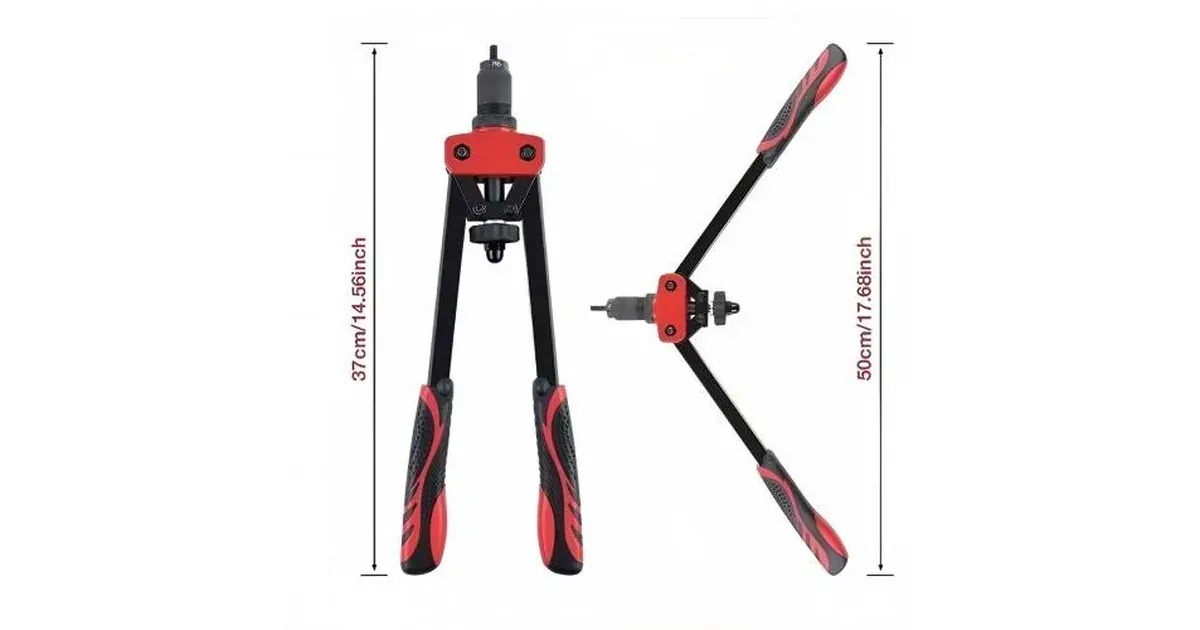
The 110P at 13 inches is the compact, portable spec — right for repair counters, small-batch fabrication and any programme where there is no air or battery supply. It ships 10 pieces per case.
The LR-HR-09 at 14 inches (about 350 mm) is the format tradespeople ask for by name, because the extra lever length means setting M8–M12 in heavier gauge does not wreck the operator's hands. It ships as a 150-piece kit: tool, interchangeable mandrels, assorted rivet nuts, wrench and a blow-moulded case, so the customer opens one case and starts work.
Our rivet nut gun buying guide compares these formats side by side, and the M3–M12 distributor guide covers how to lay out the range.
The accessory line that keeps the tool in service
Mandrels wear. A rivet nut tool with a stripped mandrel is a tool out of service, which is why every distributor running this programme should stock the mandrel sizes they sell inserts for. Interchangeable mandrels ship in the LR-HR-09 kit; additional sizes and replacements are quoted on request. Inserts themselves are the consumable — rivet nut accessories and mandrels is the repeat line.
What to check before you approve a sample
- Set the insert in the actual panel material and thickness, not a test coupon.
- Torque-test the thread to the value your customer expects, and check the insert does not spin.
- Inspect the set side: the insert should clamp evenly, with no distortion of thin sheet.
- Verify the mandrel threads against the insert — wear shows first as rounded threads.
- Record the approved sample and written specification before production.
Continue reading
Plan your riveting range with us
Send the thread sizes and insert materials your market uses, the panel thicknesses involved, and expected quantities. We will confirm the mandrel set, MOQ, lead time and sample cost in one quotation.