Buying Guides
Rivet Nut Size Chart & Grip Range
Which rivet nut for 2 mm sheet? M4-M8 standard inserts all clamp it; pick the thread by bolt load, then confirm the model's own grip band. Full M3-M12 hole and size chart.
Rivet Nut Size Chart & Grip Range Guide
Most failed rivet nuts are not a tool problem — they are a size problem. This is the thread / hole / grip reference we use when quoting rivet nut inserts for distributors, and the setting rules that keep inserts from spinning out.
By Alisa Xu, Product Manager, Ningbo Torchmark Hardware Co., Ltd. · LinkedIn · Reviewed against TORCHMARK production and sample data
A rivet nut — also called a nut insert, rivnut or blind nut — is set into a pre-drilled hole in thin sheet metal and collapses from the back as you tighten the tool, clamping the sheet between the nut head and a formed bulge. The thread it leaves behind lets a bolt be fitted from one accessible side and, unlike a self-tapping screw, be removed and refitted many times. That is why rivet nuts are standard in automotive repair, HVAC ducting, electrical enclosures, trailers and appliance panels.
The catch is that three numbers have to line up: the thread size (which sets the bolt), the hole / body diameter (which sets the drill) and the grip range (which must match the panel thickness). Get any one wrong and the insert is loose before it is even loaded. This guide gives the reference table and the setting rules for the metric range our factory supplies.
The rivet nut size chart (metric)
Use this table to pick the insert and the drill. The hole diameter should sit just above the nut body — roughly +0.1 to +0.3 mm — so the insert enters freely but does not rattle in the hole.
Thread | Nut body Ø (mm) | Drill / hole Ø (mm)* | Typical grip range - market reference (mm) | Typical use |
|---|---|---|---|---|
M3 | 4.8–5.0 | 5.0 | 0.5–3.0 | Light panels, electronics, trim |
M4 | 5.9–6.1 | 6.0 | 0.5–4.0 | Cabinets, small housings |
M5 | 6.8–7.0 | 7.0 | 0.5–4.5 | General sheet metal |
M6 | 8.8–9.0 | 9.0 | 0.5–5.0 | Automotive, HVAC brackets |
M8 | 10.8–11.0 | 11.0 | 1.0–6.0 | Structural panels, trailers |
M10 | 12.8–13.0 | 13.0 | 1.0–6.5 | Heavy brackets, equipment |
M12 | 14.8–15.0 | 15.0–16.0 | 1.5–7.0 | High-load fixing points |
* Figures are typical for standard carbon-steel and stainless rivet nuts. Body diameter, hole size and grip range vary with head style (flat, small, countersunk) and shank style (round, knurled, hex), and between manufacturers' tooling. Treat this as a reference and confirm the exact values on the quotation for the grade you buy. The model-specific bands we quote against are listed on the 110P M3-M12 rivet nut gun page; where this general market reference and a model sheet differ, the model sheet governs.
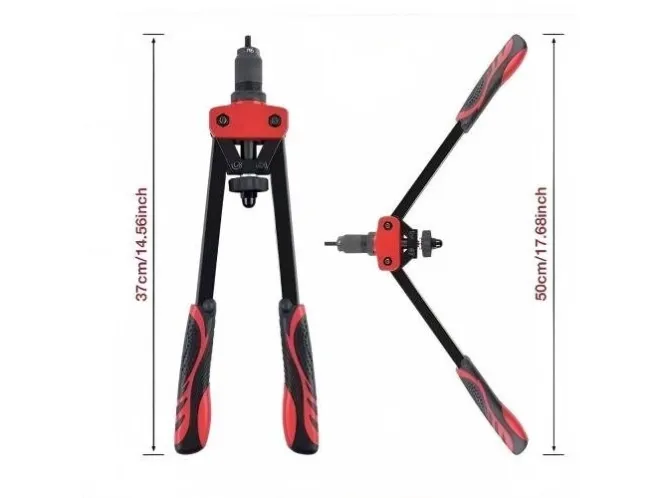
A long-handle manual tool like the TORCHMARK LR-HR-09 gives the leverage to set steel and stainless inserts cleanly — dimensions are 37 cm closed, 50 cm open span.
Which rivet nut for 2 mm sheet? A thickness-first lookup
A 2 mm panel falls inside the standard grip band of M4, M5, M6, M8, M10 and M12, so thickness alone cannot pick the thread. Thickness tells you which inserts are physically possible; bolt load, edge distance and the hole you can drill decide which one belongs on the order. Most charts run thread-first. This one runs the other way: measure the full stack first, then read across to the threads whose catalogue band contains that number.
Total material stack | Standard catalogue inserts that clamp it | Drill diameter by thread | Setting tool in our range | What to check before quoting |
|---|---|---|---|---|
0.5-1.0 mm | M3, M4, M5, M6, M8 | 5 / 6 / 7 / 9 / 11 mm | Thin sheet bulges under the setting stroke; reduce stroke and support the panel | |
1.0-1.5 mm | M3 through M12, all seven sizes | 5-15 mm | 110P or LR-HR-09 | Widest choice; select by bolt load, not by thickness |
1.5-2.0 mm | M4, M5, M6, M8, M10, M12 | 6-15 mm | 110P or LR-HR-09 | M3 drops out here; do not stretch a short-grip insert with extra stroke |
2.0-2.5 mm | M5, M6, M8, M10, M12 | 7-15 mm | 110P or LR-HR-09 | Minimum edge distance rises with hole diameter |
2.5-3.0 mm | M6, M8, M10, M12 | 9-15 mm | 110P, full M3-M12 mandrel set | Common HVAC bracket range; torque-test a sample joint |
3.0-3.5 mm | M8, M10, M12 | 11-15 mm | 110P | Near the top of the standard band; avoid the nominal edge value |
3.5-4.0 mm | M12 only | 15-16 mm | 110P | Upper limit of the standard catalogue; confirm the insert variant in writing |
Above 4.0 mm | Outside the standard catalogue band | - | - | Ask for a wide-grip or extended-body variant; get the rated band on the quotation |
The stack is everything the fastener passes through, not just the top sheet: two panels, any coating and a compressible gasket all count. A 1.0 mm steel panel over a 1.2 mm aluminium panel with a 0.2 mm gasket is a 2.4 mm joint, which moves you two rows down the table and removes M3 and M4 from the shortlist. Measure with a caliper at the hole position rather than trusting the nominal sheet gauge.
These rows follow the model-specific bands on our 110P M3-M12 gun page, which is the figure we quote against. The general chart above is a wider market reference, not a promise about a particular SKU. Where the two disagree, the model sheet wins. For the thread-to-tool decision that follows, see choosing a rivet nut gun for M3-M12.
Why the same M6 appears with two different grip ranges
Search for M6 rivet nut grip range and you will find 0.5-3.0 mm, 0.5-3.5 mm and 0.5-5.0 mm on different pages, including two different pages of this site. That is not a typo, and treating it as one is how buyers end up with an insert that cannot collapse far enough. Four things move the number.
Body length is the first. A standard short-body insert deforms over a narrow band. A multi-grip or extended-body insert has more unformed shank available, so the same M6 thread can clamp a much thicker stack. The thread does not change; the amount of tube left to bulge does.
Head style is the second. A countersunk head sits inside the panel and consumes part of the available stroke, which trims the usable band at the top end. A flat head sits on the face and keeps the full stroke.
Shank and material are the third and fourth. Knurled and hex shanks resist rotation but need a different hole and more setting force; stainless inserts need noticeably more force than aluminium to form the same bulge, so the reliable working band is narrower in practice than the theoretical one.
Finally, no two manufacturers tool the same insert identically. A published grip range is a nominal guide from that supplier's own dies, not a standard every factory shares.
For a quotation, use one rule: the general chart is for shortlisting, the model-specific band is for buying. Put the measured stack thickness, the insert grade and the required grip band into the enquiry, and ask the supplier to state the rated band for the exact item number in writing. Our hand rivet nut tools page lists the thread range, insert grades and shank options we actually supply. If a job needs a wider band than the standard catalogue, say so at enquiry stage rather than solving it with extra setting stroke on site.
Setting rules when the stack sits near a band edge
A nominal band is not a guarantee at its endpoints. Tooling tolerance, coating thickness and the give of the base material all shift where the bulge actually forms. When the measured stack lands within about 0.3 mm of either end of a band, set a sample on an offcut of the same material and thickness, then check three things: the head sits flush without panel bulge, the internal thread still accepts a bolt to full depth, and the insert does not turn under a hand torque test. If any of those fail, move to the next longer insert rather than increasing the stroke. Stainless inserts in particular punish an over-long stroke by work hardening before the bulge is fully formed.
How to read the grip range against your panel
The grip range is the range of total material thickness the insert can clamp. It is not the same as the hole depth, and it is not the same as the bolt length. Measure the panel or stack of panels the fastener passes through, then choose the insert whose grip range contains that number:
- Panel thicker than the grip range — the insert cannot collapse far enough. It sits proud, the thread is short and the joint fails early. Step up to a longer insert, or specify a variant with a wider grip range.
- Panel thinner than the grip range — the insert collapses on itself before it grips. Fit a spacer washer, or choose a closed-end / short-grip variant.
- Panel right at the edge of the range — test on an offcut first. Tooling tolerance means the nominal figure is a guide, not a guarantee.
The same logic applies to blind rivets (pop rivets): their grip range, not their diameter, decides whether the rivet clamps the joint or hangs loose. A 4.8 mm rivet still has several grip variants.
Metric or inch threads — what to stock
Metric coarse is the default for most of Europe, Asia and much of HVAC and industrial equipment. Inch UNC / UNF threads remain common in North American automotive and appliance work — #6-32, #8-32, #10-24, #10-32, 1/4"-20, 5/16"-18, 3/8"-16. A distributor serving both markets needs both, and the tool's mandrels must match: a metric mandrel will not set an inch insert. This is the single reason we configure the LR-HR-09 kit per order rather than shipping one fixed mandrel set.
Choosing the rivet nut material
Material | Grade | Best for | Sourcing note |
|---|---|---|---|
Carbon steel, zinc-plated | General fastening grade | General sheet metal, cabinets, value assemblies | Highest volume, lowest cost line |
Stainless A2 (304) | 304 | Outdoor, damp, general corrosion | Needs the long-handle tool for clean setting |
Stainless A4 (316) | 316 | Marine, chemical, food equipment | Highest corrosion resistance |
Aluminium | — | Light load, soft or thin panels | Easiest to set; avoid high-torque joints |
Two practical rules we pass on to every buyer: stainless inserts need noticeably more setting force (the installation torque runs roughly a third higher than aluminium), which is why the long-handle tool matters; and soft or thin panels call for a slightly smaller hole, while a steel panel wants a slightly larger one, because the base material's own give changes how the bulge forms.
Head and shank styles — where they matter
- Flat head — the general-purpose default; sits on the panel face.
- Small / low-profile head — minimal protrusion where clearance is tight.
- Countersunk head — flush fit into a countersunk hole for a flat surface.
- Round shank — relies on friction; fine for light duty.
- Knurled shank — the knurl bites into the panel and resists rotation under torque. The right choice where a bolt will be repeatedly removed and refitted.
- Hex / square shank — the strongest anti-rotation option; needs the matching shaped hole.
The four failures we see, and their fixes
- Insert spins when the bolt is tightened. Oversized hole or an insert that was never set fully. A hole more than about 0.2 mm oversize can cut anti-torque resistance by around 20%. Fix: correct drill size, full set, and a knurled or hex shank for high-torque joints.
- Panel bulges or cracks. Too much setting stroke, or too large a hole combined with a thin panel. Fix: reduce the stroke, check the grip range and support the panel during setting.
- Insert sits proud / thread is short. Grip range too small for the panel. Fix: longer insert or a wider-grip variant.
- Thread cross-threaded or damaged on the first bolt. Bolt forced into a slightly mis-set insert. Fix: set fully and squarely, and start the bolt by hand before applying torque.
Setting a rivet nut cleanly — the six steps
- Drill the correct hole for the nut body; deburr both faces.
- Check the panel thickness against the insert grip range.
- Thread the insert onto the correct mandrel; set the tool stroke per the insert size.
- Insert the nut into the hole and hold the tool square to the panel.
- Squeeze the handles through the full stroke — do not stop halfway.
- Reverse the tool to release; confirm the insert is flush, square and cannot be turned by hand.
Stocking checklist for distributors
- Cover the thread ladder, not one size. Stock M3–M12 (and the inch equivalents for North America) so any panel your trade encounters can be served.
- Carry both materials. Zinc-plated steel as the volume line, A2/A4 stainless for the corrosion-critical end.
- Match the tool to the threads. A kit with interchangeable mandrels avoids dead stock and lets one box serve the whole ladder.
- Keep blind rivets alongside. Where a rivet nut gun is impractical (light ducting, louvres), a pop rivet of the matching grip range finishes the job.
Sourcing rivet nut tools and inserts for resale? Send the thread sizes, panel thickness and material you sell most. We confirm the mandrel set, insert grade and grip range, and quote the tool and fasteners together in one shipment.Request a quote
Frequently asked questions
Which rivet nut size do I need for 2 mm sheet metal?
Thickness does not fix the thread. At 2 mm, M4, M5, M6, M8, M10 and M12 standard inserts can all clamp the joint. Choose the thread from the bolt load and the space available for the hole, then confirm that the exact insert's rated grip band contains 2 mm with margin on both sides. A 2 mm stack sitting at the very bottom of a band is a warning sign, not a fit.
Why does one M6 insert list 0.5-3.0 mm and another 0.5-5.0 mm?
Because they are different inserts. A standard short-body M6 and a multi-grip or extended-body M6 share a thread but not a deformable shank length. Head style, material and the supplier's tooling shift the band further. The general chart on this page spans the market; the model-specific table on our 110P page is the band for that catalogue item. Quote against the model-specific figure.
What size hole do I drill for an M6 rivet nut?
A standard M6 rivet nut has a body diameter of about 8.8–9.0 mm and calls for a drill hole of around 9.0 mm — just above the body so the insert enters freely without being loose. Confirm against the exact grade and head style you buy.
How do I choose the right grip range?
Match it to the total panel thickness: M3 about 0.5–3.0 mm, M4 0.5–4.0 mm, M5 0.5–4.5 mm, M6 0.5–5.0 mm, M8 1.0–6.0 mm, M10 1.0–6.5 mm, M12 1.5–7.0 mm. Too thick and the insert cannot collapse; too thin and it collapses before gripping.
Why does my rivet nut spin when I tighten the bolt?
An oversized hole or an insert that was not set fully, so it never gripped the sheet. A hole more than about 0.2 mm oversize can cut anti-torque by around 20%. Use the correct drill size, set fully, and choose a knurled or hex shank for high-torque joints.
Can one tool set both steel and stainless rivet nuts?
Yes, if it has enough leverage. Stainless installs at roughly a third more torque than aluminium, so a long-handle tool such as the 14-inch LR-HR-09 sets aluminium, steel and stainless from one unit — a compact tool often cannot.
Metric or inch rivet nuts — which should I stock?
Metric coarse for most of Europe, Asia and industrial equipment; inch UNC/UNF for much North American automotive and appliance work. Serving both markets means stocking both thread families and matching mandrels.
Related reading
See the full tool and fastener range on our hand rivet nut tools & fasteners page — the 14-inch LR-HR-09 kit, rivet nut inserts, TR-RIV blind rivets and TR-STS threaded stud bolts.
Also in the TORCHMARK riveting and fastening series: our rivet nut gun buying guide for hardware distributors, and for the wider range see the PVC/PPR pipe tools and hydraulic crimping tools.
Explore the full TORCHMARK tool range Flaring, drain cleaning, riveting, lubrication, crimping and pipe tools — product pages and B2B buying guides in one place.Browse all products → Frequently asked questions
How do I read a rivet nut size?
By thread, grip range and required hole size. The thread tells you what fastener fits; the grip range tells you which sheet thicknesses it will clamp; the hole size tells you what to drill.
What happens if the grip range is wrong for the sheet?
Too thin and the insert will not clamp — it spins. Too thick and it will not set fully, leaving the thread distorted. Always match grip range to the actual sheet thickness.
Is the drill size the same as the thread size?
No. The hole is larger than the nominal thread. Use the size stated for the insert you are setting rather than deriving it from the thread.
Do aluminium, steel and stainless inserts use the same hole?
The hole size follows the insert, so confirm against the insert specification. Material affects setting force rather than hole size — and stainless needs the most force.
Which sizes should be stocked as spares?
The two or three thread sizes that carry most of your demand. Mandrels wear, so spares are the repeat-order line in this category.
Where do I confirm a size before ordering?
Send the thread, sheet thickness and insert material and we will confirm the grip range and drill size against the listed configuration.
Related products
Rivet nut tools and kits
- 110P 13-inch rivet nut gun M3–M12 — listed sizes M3, M4, M5, M6, M8, M10, M12
- LR-HR-09 14-inch rivet nut tool kit — interchangeable mandrels, assorted inserts, blow-moulded case
Adjacent categories
Related guides
- Rivet nut gun buying guide — range, leverage and wear parts
Request a quote
Send the thread sizes, sheet thicknesses, insert materials, mandrel assortment, quantity and destination port. We will confirm the configuration and return price, MOQ and lead time.
amy@longrunhardware.com · alisa@longrunhardware.com · · WhatsApp +86 158 6745 7689Drill bit size for rivet nuts: how to get it right first time
Every size-chart question eventually turns into the same practical one: which drill bit do I use to open the hole? The answer sits with the insert you are installing, not with the thread designation alone, and getting it wrong is the single most common reason a rivet nut spins in the panel instead of gripping it.
Start from the insert manufacturer's specified hole diameter
Rivet nuts are specified by thread size, grip range and required hole diameter. The hole diameter is published by the insert manufacturer and is normally given to one decimal place in millimetres (for example, a value ending in .0 mm). It is deliberately larger than the thread's nominal diameter, because the body of the insert has to pass through the sheet. Work from that published figure, then check it against the insert's own packaging or datasheet before you cut production parts.
When the figure comes in inches instead of millimetres
North American drawings frequently list the hole as an inch fraction or a decimal in inches. The conversion is fixed: one inch equals 25.4 millimetres. Convert first, then choose the metric drill closest to the converted value, rounding up rather than down if the exact size is not stocked — an undersized hole prevents seating, while a marginally larger one is more forgiving than one that is too tight.
Why the hole size tolerance decides whether the joint holds
- Oversized hole: the insert body has too much clearance, the knurl or splines cannot bite, and the nut spins when you torque the bolt.
- Undersized hole: the insert will not enter cleanly, so it is driven in off-square and the flange does not sit flat on the sheet.
- Oversized by a small margin on a soft sheet: common complaint with aluminium panels, where the insert collapses unevenly and the grip range effectively shifts.
Pilot a test piece on every new sheet thickness or material, especially when switching between aluminium, mild steel and stainless inserts, since the recommended hole can differ between them even at the same thread size.
Metric or UNC threads — and where our tools sit
Our rivet nut tools are built around the metric range most requested by distributors, from M3 through M12, which covers the majority of appliance, HVAC bracket and light assembly work. Inch threads (typically UNC sizes) appear in North American service work; if your customers need both, stock the metric set as the volume line and reference the UNC sizes separately, because the mandrels and nose pieces are not interchangeable across thread standards.
Related tools and guides
- Related Longrun product:
- LR-HR-09 14-Inch Rivet Nut Tool KitSmall-batch orders and private-label options
We work with importers, distributors and equipment brands of every size. If you are testing a new market or building a private-label range, you are not required to commit to a full container on the first order — we accept small trial quantities and can confirm the applicable minimum for each item in the quotation.
For rivet nuts and setting tools, we can discuss metric and inch thread ranges, grip ranges matched to your panel thickness, head and shank styles, and the packing or carton marking you need for your own catalogue. Send us the panel thickness, thread specification and target quantity, and we will come back with the matching model, packing and order terms confirmed per order.
What to include in your enquiry
- Panel thickness and material, and the metric or inch thread you stock.
- Estimated quantity for the first trial order and expected repeat volume.
- Any private-label requirement (handle colour, logo, carton marking) — subject to what is printable on the listed model.
- Your destination port and inspection point, so we can quote packing and documents accurately.
Small batches can be placed through our own ordering platform. Use the enquiry options below, or contact our team directly, and we will confirm availability, packing and order terms per order.