Buying Guides
Choosing a Rivet Nut Gun for M3-M12 Inserts
Specify a rivet nut gun from the insert, not the price: match the mandrel range to the M3-M12 thread, then confirm leverage, insert material, quality control and parts support.
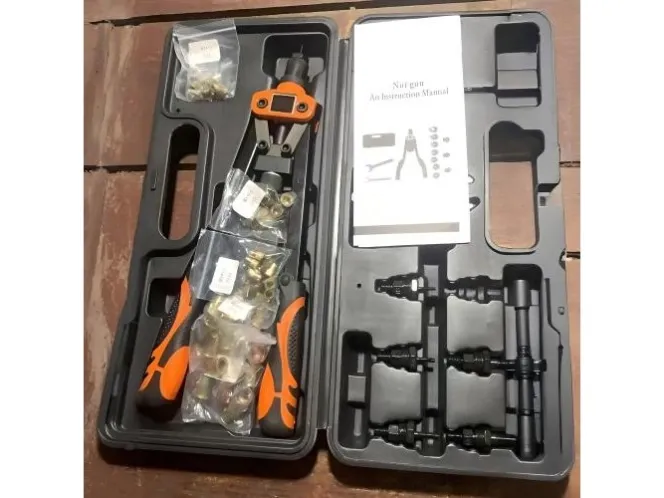
How to Choose a Rivet Nut Gun for M3-M12 Inserts
A rivet nut gun installs threaded inserts in a workpiece, allowing a bolt to engage the insert from one accessible side. Tool selection should follow the insert specification and application requirements. For distributors and private-label buyers, the correct tool depends on mandrel range, insert material, leverage, parts support and quality control—not price alone.
- Match the Mandrel Range to Demand List the thread sizes your customers actually use and confirm the mandrel and nosepiece supplied for each size. An M3-M12 label describes a size range, not a guarantee that the tool sets every insert material throughout that range. Request a size-by-material capability table before comparing quotations.
- Compare Leverage and Access Check the space needed to open and close the handles and to keep the tool aligned with the insert. Evaluate a sample in the intended assembly position; handle length alone does not establish the material or size capacity.
- Confirm Insert Materials Ask the supplier which sizes are suitable for aluminum, steel and stainless-steel rivet nuts. The highest-force combinations may require a larger tool or specific mandrels.
- Audit Wear Parts and QC Procurement teams should confirm mandrel hardness, thread accuracy, handle alignment, jaw condition, cycle testing and spare-mandrel availability. These checks reduce stripped threads and warranty returns.
- Specify Packaging and OEM Details Define mandrel assortment, wrench/accessory inclusion, case or carton format, barcode, logo, instructions and spare-parts labeling before mass production.
RFQ Checklist
• Mandrel sizes and insert materials
• Expected order quantity and destination market
• Packaging and private-label requirements
• Sample and inspection standard
• Spare mandrel requirements
Before requesting a quote, provide the insert thread size and material, workpiece thickness, hole specification, quantity per model and destination. Confirm insert grip range with the insert supplier and approve a sample in the intended workpiece.
Mixed orders are accepted. Samples are charged; sample shipping is refunded after an order is placed. Typical lead time is 15–45 days, subject to the confirmed order.
Browse our current product range:
ABOUT THE AUTHOR
Alisa Xu — Product Manager, Ningbo Torchmark Hardware Co., Ltd.
Phone: 0086-13429254575
LinkedIn: https://www.linkedin.com/in/alisasourcing/What “M3–M12” does and does not promise
The five checks above describe how to evaluate a rivet nut gun. The phrase that causes the most trouble in an enquiry is the range itself. “M3–M12” describes the mandrel and nosepiece sizes a tool is listed with. It does not promise that every size in that span can be set into every insert material at full production rate.
Take the 110P as the working example. It is a 13-inch manual rivet nut gun listed with mandrels and nosepieces in M3, M4, M5, M6, M8, M10 and M12, packed 10 pieces per case. Seven discrete sizes, not a continuous range. If your market uses M7 or an imperial equivalent, that is a separate confirmation, not an assumption.
Specification block for your enquiry
Paste this into the RFQ so every supplier prices the same scope. Lines left blank are the usual reason two quotations cannot be compared.
Parameter | What to state |
|---|---|
Model | 110P manual rivet nut gun |
Tool length | 13 inches |
Mandrel range | M3 – M12 (listed sizes M3, M4, M5, M6, M8, M10, M12) |
Thread system | Metric; state if UNC/UNF also required |
Insert materials | Aluminium, steel, stainless — confirm which per size |
Mandrels supplied | Which sizes must be in the box, and spares quantity |
Packing quantity | 10 pieces per case as standard; state if different |
Accessories | Wrench, spare mandrels, case or carton format |
QC acceptance | Thread gauge method and sample size per batch |
Exact configuration is on the 110P 13-inch rivet nut gun page. If your customers want a kit rather than a bare tool, the LR-HR-09 14-inch rivet nut tool kit is a 150-piece set with interchangeable mandrels, assorted inserts and a blow-moulded case.
Matching the tool to the work
Which sizes your market actually buys
Before you choose a range, list the thread sizes your customers order by volume. In most distributor ranges two or three sizes account for the majority of demand. Buying the full M3–M12 span makes sense when the kit is sold as a set; it makes less sense when the tool is sold bare and mandrels are bought as spares.
Insert material drives the force requirement
Aluminium inserts set with modest force. Steel needs more. Stainless steel needs the most, and it is the size where a hand tool stops being comfortable — typically at the top of the range. Confirm per size which insert materials the tool is intended for, and treat stainless at the largest size as a question to be answered by a sample rather than by a specification sheet.
Access and handle sweep
A 13-inch tool needs room to open. In ducting, enclosure work and automotive repair the constraint is often not force but clearance. Evaluate in the actual assembly position.
Four specification mistakes on rivet nut gun orders
Treating the range as continuous
The listed sizes are discrete. Name the ones you need and confirm each individually.
Specifying the tool but not the mandrel set
A bare tool without the mandrels your customers need is unsellable. State which sizes ship in the box and how many spares.
Assuming stainless performance from a steel rating
Ask for the insert-material statement per size, in writing, before approval.
Skipping the thread gauge
A mandrel that has worn or a thread that has been cut slightly oversize produces inserts that spin. Agree the gauge method and the sample size with the order, not after delivery.
Quality checks before shipment
Mandrel hardness and thread accuracy
Mandrels are the wear item. Confirm hardness and thread accuracy, and confirm spare availability, because a tool without a replacement mandrel is a warranty claim waiting to happen.
Handle alignment and jaw condition
Check that the handle pulls true and that the nosepiece seats squarely. Misalignment shows up as inserts set at a slight angle, which is enough to cause cross-threading downstream.
Pull-out and spin test
Set inserts into the actual sheet thickness your customers use — not into a thinner test panel — and check for spin.
Packaging, kitting and private label
Formats that sell in this category
Blow-moulded cases suit kit and retail programmes; cartons suit industrial supply where the tool is one line among many. A 150-piece kit and a bare 10-per-case tool address different buyers, and many distributors list both.
What to specify before production
Mandrel assortment, wrench inclusion, case or carton format, barcode, logo position, instruction language and spare-part labelling. Send artwork with the enquiry so printed components are ready when the tools are.
MOQ, lead time and landed cost
Building the first order
Mixed allocation is supported on kit programmes from 500 pieces, which lets a first container carry both a kit and a bare tool. Freight on a part container is disproportionate, so consolidating two lines in one shipment usually improves the landed cost of both.
Samples before commitment
Paid samples are available and specification is confirmed before bulk approval. Use the sample to test the largest insert size in the hardest material you intend to sell against.
Frequently asked questions
Does the 110P cover every size between M3 and M12?
It is listed with mandrels and nosepieces in M3, M4, M5, M6, M8, M10 and M12. Those are discrete sizes; confirm any other size you need rather than assuming it falls inside the range.
Which insert materials can it set?
Aluminium, steel and stainless are the usual question. Confirm per size — stainless at the top of the range is the combination to test on a sample first.
How many pieces per case?
10 pieces per case is the standard packing quantity for the 110P. Kit configurations differ; the LR-HR-09 is supplied as a 150-piece set.
Can we buy spare mandrels separately?
Yes. Confirm the spare list and quantities with the quotation so they can be listed alongside the tool rather than sourced later.
Do you support private label?
Yes — logo position, case or carton format, barcode and instruction language are specified before production. Send artwork with the RFQ.
What is the MOQ?
Kit programmes start from 500 pieces with mixed allocation supported. Ask for the figure that applies to your exact configuration, because packaging format moves it.
Where to go next
- 110P 13-inch rivet nut gun M3–M12 — configuration and packing
- LR-HR-09 14-inch rivet nut tool kit — 150-piece set for kit programmes
- Hand rivet nut tools — full manual range
- Rivet nut gun buying guide — range, leverage and wear parts
- Rivet nut size chart — thread, grip range and drill size
- Sourcing FAQ — catalogue, factory audit, import and payment
Request a quote
Send the thread sizes, insert materials, mandrel assortment, packaging format, quantity and destination port. We will return price, MOQ, lead time and sample cost in one reply.
For the full range, see the rivet nut tools category covering manual and pneumatic tools, kit contents, thread sizes and carton data for distributors.Small trial orders for rivet-nut ranges
To qualify a rivet-nut range, a small trial order covering the thread sizes and grip ranges you stock is a practical start. We confirm the applicable minimum for each item in the quotation.
Send the thread size, grip range, panel thickness and your first-order quantity, and we will confirm the matching tool, mandrels and terms per order.