Riveting & Fastening Tools
110P 13-Inch Rivet Nut Gun M3-M12
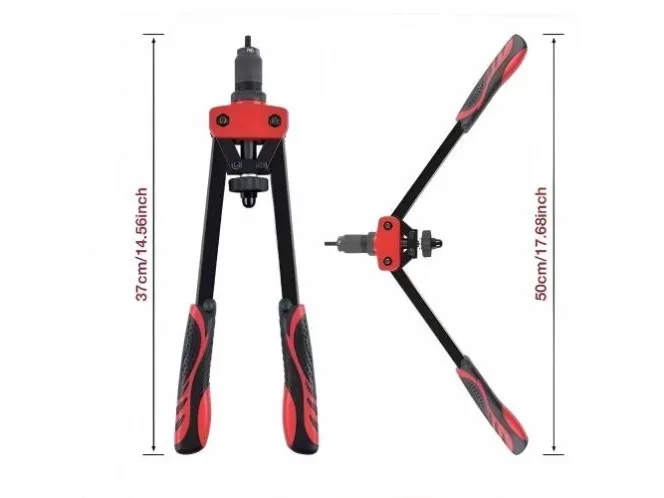
110P 13-inch rivet nut gun with M3-M12 mandrels and nosepieces. Check insert material and accessory list before ordering. 10 pcs per box.
What the 110P is
The 110P is a manual rivet nut gun listed in the Torchmark catalog at 13 inches. Catalog accessory sizes are M3, M4, M5, M6, M8, M10 and M12, with a packing quantity of 10. It is a hand tool, not a power tool: the operator squeezes the handles to collapse the insert, which suits repair counters, small-batch fabrication and distributor assortment programmes where air or battery supply is not available.
Catalog specifications
Item | Value |
|---|---|
Model | 110P |
Tool type | Manual rivet nut gun |
Length | 13 inches |
Mandrel range | M3 - M12 |
Standard quantity | 10 pieces per case |
Thread system | Metric |
Source: Torchmark Riveting & Fastening catalog. Values are catalog list values; confirm the current revision with your quotation before placing a bulk order.
Key buyer benefits
- Wide M3-M12 mandrel range for common metric rivet nuts
- 13-inch handle length for efficient manual setting
- Interchangeable mandrels support distributor assortment programmes
- Suitable for repair, sheet-metal and light fabrication channels
- OEM/private-label packaging and sample support
Mandrel and nosepiece sizing
The listed range across M3, M4, M5, M6, M8, M10 and M12 describes the mandrel and nosepiece sizes catalogued for this tool. It is not a compatibility guarantee for every insert material. Rivet nut behaviour changes with material, wall thickness of the parent panel, grip range and hole tolerance, so the fastest way to avoid a rejected lot is to confirm the exact insert you will use and then verify the matching mandrel in a sample before a bulk order.
Quality questions for sourcing
Confirm mandrel hardness, thread accuracy, handle alignment, spare-parts availability, cycle testing and packaging protection before placing a bulk order. Buyers supplying OEM and aftermarket channels should also ask for a dimensional report on the mandrel set, because a mandrel that is outside tolerance will damage threads on every insert in the kit rather than failing visibly.
RFQ checklist
- Required mandrel sizes inside the M3-M12 range
- Insert material and workpiece panel thickness
- Order quantity and expected annual volume
- Destination market and any labelling requirements
- Packaging preference (catalogue packing, blister, colour box, private label)
- Logo requirement and artwork file
- Sample request and sample approval criteria
Send the items above in one message and we will reply with a model-specific quotation. Samples are available for distributors evaluating the range.
Related tools and guides
- Hand rivet nut tools - the full manual rivet nut gun range
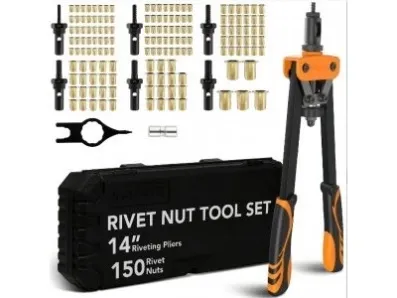
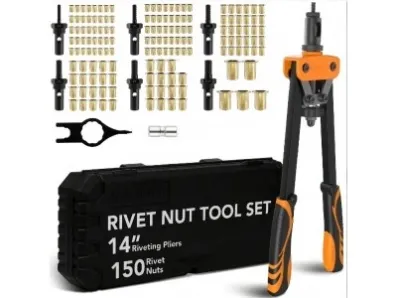
- LR-HR-09 rivet nut tool kit - kit format with mandrel and nosepiece set
- Rivet nut size chart guide - metric sizing reference
- Rivet nut gun buying guide - manual vs power comparison
- Choosing an M3-M12 rivet nut gun for distributors - assortment planningTalk to our export team
Send the model numbers, quantities, packaging requirement and destination port, and we will quote price, MOQ, lead time and sample cost in one reply.
A rivet nut is sized twice: once by thread, and once by the sheet it has to grip. The thread decides which mandrel and nosepiece you fit to the 110P; the sheet thickness decides whether the insert forms a bulge that actually clamps. Get the second one wrong and the insert spins under torque, which is the single most common return reason on threaded inserts.
Thread | Hole diameter in sheet | Typical grip range | Minimum edge distance | Where it is used |
|---|---|---|---|---|
M3 | 5.0 mm | 0.5–1.5 mm | 6 mm | Light enclosures, instrument panels |
M4 | 6.0 mm | 0.5–2.0 mm | 7 mm | Control boxes, thin sheet covers |
M5 | 7.0 mm | 0.5–2.5 mm | 8 mm | Ductwork flanges, brackets |
M6 | 9.0 mm | 0.5–3.0 mm | 9 mm | HVAC cabinets, general fabrication |
M8 | 11.0 mm | 0.5–3.5 mm | 12 mm | Automotive panels, machine guards |
M10 | 13.0 mm | 1.0–3.5 mm | 14 mm | Chassis work, heavier brackets |
M12 | 15.0 mm | 1.0–4.0 mm | 16 mm | Structural fixings, equipment frames |
Treat the grip range as a starting point and confirm against the insert supplier's spec sheet, since body length and knurl pattern move it. The full body, hole and grip table is maintained in our rivet nut size chart; if you are choosing between a bare gun and a kit, start with the rivet nut gun buying guide.
Setting an insert with the 110P, step by step
The 110P is a hand-operated setter: the mandrel pulls the insert body while the nosepiece stays against the sheet. Everything that goes wrong in the field traces back to one of the four steps below.
Drill and deburr the hole
Drill to the hole diameter for the thread, not to the thread diameter. A hole drilled one size up removes the material the bulge needs to clamp against. Deburr both faces — a burr holds the sheet off the nosepiece and produces a set that looks correct and pulls out later.
Thread the insert onto the mandrel
Run the insert onto the mandrel by hand until it seats; do not start it under lever pressure. A cross-started insert damages the mandrel thread, and a damaged mandrel then damages every insert set afterwards. Keep a spare set from rivet nut accessories and mandrels on the shelf — mandrels are the part that wears first.
Set the stroke and pull
Keep the nosepiece square to the sheet and pull in one continuous stroke. Partial strokes produce a partially formed bulge that grips at the front and slips at the back — the failure shows up only when the assembly is torqued.
Inspect the set insert
Check three things: the head sits flush, the thread gauge passes, and the insert does not turn when the bolt is torqued to spec. One insert per batch should be sectioned or pull-tested and the result recorded.
Field failures and what they mean
When an end user reports a problem, the symptom tells you which step failed. This is the diagnostic list worth handing to a buyer alongside the tool.
The insert spins in the sheet
Almost always a hole drilled oversize, or an insert whose grip range does not reach the sheet thickness. Check the hole with a gauge before concluding the tool is at fault, and confirm the grip range against our rivet nut size chart.
The thread strips during setting
Usually a mandrel that is worn or the wrong pitch for the insert, or a cross-start. Replace the mandrel and re-test — mandrels are consumables, not lifetime parts.
Handle effort rises over a shift
Caused by dry mandrel threads and no lubrication on the pivot points. A drop of oil on the mandrel thread and a wiped-down nosepiece restores most of the lost effort.
110P or LR-HR-09: which one belongs in your range
Both set threaded inserts; they serve different buyers. Stocking both is normal, and the split depends on whether your customers are workshops or fabrication shops.
When the 110P is the right line
The 110P suits the maintenance buyer who needs M3 to M12 on existing equipment and one tool in the bag. It is the lower ticket, higher volume line, and it pulls the consumable inserts and mandrels behind it. Browse the wider rivet nut tools range for how it sits alongside the rest.
When a kit sells better
A first-time buyer or a workshop setting up a new line prefers the LR-HR-09 14-inch kit, because the mandrels, inserts and case arrive together. Kit buyers are also the group most likely to reorder inserts.
Stock, spares and what repeats
The tool is a one-time sale; the inserts and mandrels are the account. Plan the consumable line with the tool, not after it. Rivet nut accessories cover inserts in aluminium, steel and stainless with mandrels and nosepieces for the 110P, and hand rivet nut tools cover the adjacent formats buyers ask for next.
FAQ
What thread range does the 110P cover?
M3 through M12, with the matching mandrel and nosepiece fitted for each size. Confirm the accessory list on the quotation, since kits and bare tools ship with different contents.
Which insert material should I stock?
Aluminium for light sheet and corrosion resistance, steel for general fabrication, stainless for outdoor and wash-down environments. Match the insert to the parent metal to avoid galvanic corrosion.
Why does an installed rivet nut spin?
Because the hole is oversize or the grip range does not reach the sheet thickness. Check the hole diameter with a gauge before replacing the tool or the insert batch.
How often do mandrels need replacing?
Mandrels are consumables. Replace at the first sign of thread wear or rising handle effort — a worn mandrel damages every insert set afterwards.
Is the 110P suitable for production work?
It is designed for maintenance, repair and low-volume assembly. For repeated daily setting on a line, a pneumatic or hydraulic setter is the correct specification.
Can inserts and the gun ship in one order?
Yes. Inserts, mandrels and nosepieces are stocked as separate lines and can be consolidated with the tool into one shipment to spread freight.
The band in this table is the TORCHMARK standard catalogue figure we quote against. The rivet nut size chart and grip range guide publishes a wider general market reference and explains why the two figures differ; use this model table when specifying an order.