Buying Guides
PVC Pipe Cutter & PPR Welder Buying Guide
Choose a PVC pipe cutter by diameter and a PPR socket fusion welder by pipe size: sizing table plus the checks that prevent cracks and leaks.
PVC Pipe Cutter & PPR Welder Buying Guide
A practical way to match a plastic pipe cutter to pipe diameter and material, and to pick the right PPR welder — with the checks that stop cracked cuts and leaking joints before they reach the customer.
Published 11 October 2026
Most plastic-pipe problems are not quality problems — they are tool-choice problems. A cutter bought one size too small cracks the pipe at the wall; a welder that never reaches temperature makes a joint that looks welded and weeps six months later. This guide is the sizing conversation we have with distributors and plumbing merchants every week, written down so you can specify the right tool before you place an order.
Everything below is drawn from the tools we actually manufacture — the 32 / 36 / 42 / 63 mm ratchet pipe cutters and the gas-powered PPR socket fusion welder — so the figures are real production numbers, not round marketing figures.
Step 1: Start from the pipe, not the tool
Before opening any catalogue, list two numbers: the smallest pipe you cut regularly (often a 20 mm service or conduit) and the largest pipe you cut routinely (soil stack, drainage or main). The cutter you need spans that band — with margin above the top end, because the biggest pipe on a job site is usually bigger than the one on your desk. For welding, list the PPR diameters you join most (typically 20 / 25 / 32 mm); a welder is defined by its die-head set, not by its wattage.
The reason the top end matters most is force and heat. A ratchet cutter must generate enough squeeze to shear thick-wall pipe without the blade skidding; a welder must hold the fusion temperature through every joint. Buying to your average job, not your biggest, is how tools come back under warranty.
Step 2: Match the cutter diameter to the pipe
Because pipe sizes arrive in millimeters and inches, keep the conversion to hand. The table pairs the common pipe diameters with the cutter that cuts them cleanly:
Pipe diameter | ≈ inch | Typical use | Right cutter |
|---|---|---|---|
20 mm | ¾" | PPR service, conduit, micro-irrigation | 32 mm portable / 42 mm labor-saving |
25 mm | 1" | PPR cold/hot water, PE irrigation | 42 mm labor-saving / 36 mm |
32 mm | 1-1/4" | PPR riser, PE supply | 42 mm labor-saving (3–42 mm) |
36 mm | 1-3/8" | PPR / PE medium pipe | 36 mm labor-save cutter |
42 mm | 1-5/8" | PPR / PE larger supply | 42 mm professional / automatic |
63 mm | 2-1/2" | Soil, waste, drainage, ABS | 63 mm automatic heavy-duty ratchet |
Working diameters from the TORCHMARK 32 / 36 / 42 / 63 mm ratchet cutter range. Treat the inch column as an approximation — always confirm the exact pipe you sell, because wall thickness changes the force needed.
Rule of thumb for margin Choose a cutter whose top rating is at least one size above your largest routine pipe. If you routinely cut 42 mm, the 42 mm cutter is the tool — but if you also meet 63 mm drainage, stock the 63 mm frame rather than forcing a small cutter past its limit and cracking the pipe.
Step 3: Ratchet cutter or saw? The ratchet wins on plastic
On plastic pipe, a ratchet cutter is genuinely the better tool, and not just because it is faster. A saw teeth the pipe and leaves a burr that jams in the fitting; a ratchet cutter scores and shears in one controlled stroke for a square, burr-free cut that seats fully in the socket. The ratchet also multiplies hand force, so thick-wall pipe is cut without the blade skidding or the pipe cracking. This is why a plumbing wall — and a well-stocked merchant's shelf — carries ratchet cutters in the diameters the local market installs, not a hacksaw.
Step 4: Pipe material — one cutter, many plastics
The ratchet plastic pipe cutters cut PVC, PPR, PE, PP and PEX; the larger 63 mm frame also handles ABS and thicker-wall drainage pipe. The variable is the blade: a sharp, replaceable high-carbon steel or stainless-iron (Teflon-surface) blade shears cleanly, while a dull one tears. Stock replacement blades, and the cutter stays useful for years instead of one season.
Step 5: Electric or gas PPR welder?
The two welder formats solve different power problems:
- Electric socket fusion welder — standard for a workshop or anywhere with reliable power. Plug in, heat the die heads to ~260–280°C, and join 20 / 25 / 32 mm PPR. Simple, repeatable, no fuel to carry.
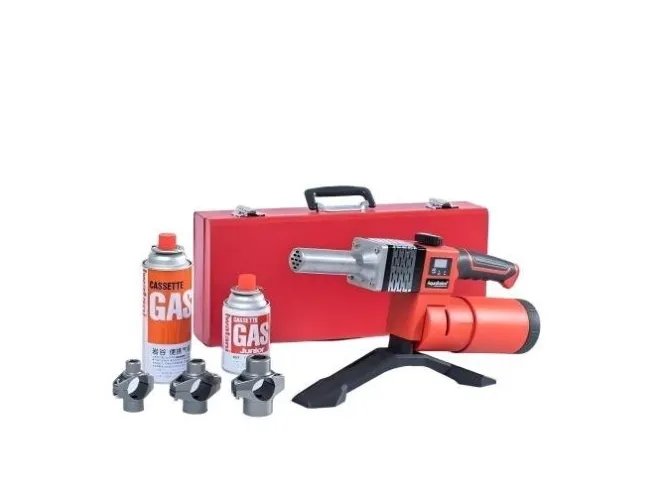
- Gas-powered socket fusion welder — a motor-free unit heated by a butane/propane cassette. Ours reaches 280°C in about 3 minutes 30 seconds (roughly 30% faster than the battery models we tested), at 1.4 kW and 1385 g bare. This is the field tool: trenches, rooftops, wetlands and emergency repair where there is no socket to plug into.
For a plumbing merchant serving both contractors and installers, the shape that sells is predictable: a couple of electric welders for the bench, plus one or two gas welders for the field crews who cannot reach power.
Step 6: The eight checks before you buy
These are the points that separate a tool that lasts a decade from one that returns inside a year. Run through them with any quotation:
- Diameter brackets your work — with margin above your largest routine pipe.
- Blade is replaceable — a sealed, non-replaceable blade turns a good cutter into landfill the day it dulls.
- Body suits the pipe — aluminium alloy + TPR for the heavy 63 mm frame; ABS + rubber grip for the lighter 32–42 mm cutters.
- For welders, confirm heat and time — PPR fuses around 260–280°C; a welder that cannot hold it makes weak joints. Ask for the heating time to 280°C.
- Die-head set matches your pipe — 20 / 25 / 32 mm as standard; confirm the heads are aluminium die-cast and the sizes you sell.
- Fuel or power is practical — gas welders need a standard cassette canister; electric welders need the right voltage for your market.
- Spares are available separately — a cutter you cannot buy blades for, or a welder without die heads, is a paperweight.
- Sample confirmed — cut a scrap of your own pipe and make a test fusion before committing to the order.
What a "good" result looks like A correct cut is square and burr-free, with the pipe seating fully into the fitting. A correct PPR fusion shows an even, slightly raised bead at the joint and a pipe that does not rotate or pull out. If the cut is ragged or the bead is thin and the pipe turns, the tool was wrong-sized or the welder was off-temperature — not necessarily faulty.
Common mistakes we see from buyers
Three recur often enough to name. First, buying on price per cutter and ending up with a frame whose diameter stops below the customer's real work — the 63 mm job then gets forced through a 42 mm cutter and the pipe cracks. Second, ignoring the welder's heat and time — a cheap welder that takes ten minutes to temperature quietly produces weak joints. Third, forgetting the field, then discovering the electric welder cannot reach the trench. Each is avoidable with the checklist above, and each is why we ask for the pipe diameters, material and power situation before quoting.
Building a PVC/PPR range to sell
If you are a merchant building a plastic-pipe line rather than choosing a single tool, the shape that sells is predictable: a 32 mm and a 42 mm cutter for the volume of service and supply pipe, a 63 mm frame for soil and drainage, and the welders — electric for the bench, gas for the field. Fewer SKUs than a full wall, but each one answers a real job. We build that range as one family, so a single order covers cutters and welders with matched blades and OEM branding.
Tell us your pipe diameters and material Send the smallest and largest pipe you cut, the PPR sizes you join, and electric / gas welder preference. We confirm the right models, blades and lead time.See the PVC/PPR range
Frequently asked questions
What size PVC pipe cutter do I need?
Match the cutter to the largest pipe you cut most. A 32 mm portable suits thin-wall PVC-U; a 42 mm cutter covers PVC, PPR, PE and PEX up to 1-5/8"; a 63 mm automatic ratchet frame is for soil, waste and thicker drainage pipe. Cutting above the rated diameter cracks the pipe.
Can one pipe cutter handle PVC, PPR, PE and PEX?
Yes. Ratchet plastic pipe cutters cut PVC, PPR, PE, PP and PEX, and the 63 mm frame also handles ABS and thick-wall drainage pipe. A sharp, replaceable blade keeps the cut clean rather than tearing.
Electric or gas PPR welder — which should I stock?
For a workshop with reliable power, an electric socket fusion welder is standard. For field work, rooftops, trenches, wetlands and emergency repair with no power, a gas-powered welder is better — it reaches 280°C in about 3.5 minutes on a butane/propane cassette. Many distributors stock both.
Why does heating time matter for a PPR joint?
PPR fuses properly only in a narrow band around 260–280°C. A welder that is slow to heat or drifts in temperature makes a joint that looks welded but never fully fuses and weeps later. A gas welder that reaches 280°C in roughly 3.5 minutes and holds it produces reliable joints.
Should I use a ratchet cutter or a saw on plastic pipe?
Use a ratchet cutter. A saw teeth the pipe and leaves a burr that jams in the fitting; a ratchet cutter scores and shears in one controlled stroke for a square, burr-free cut that seats fully in the socket, and multiplies hand force so thick pipe is cut without cracking.
Related reading
See the full tool range on our PVC pipe cutters & PPR pipe welders page, or explore the rest of the TORCHMARK line via the pump oil can collection and the hydraulic crimping tools.
Explore the full TORCHMARK tool range Product pages and B2B buying guides in one place.Browse all products → The tools this guide refers to
- TB365 tube bender set, 1/4 to 7/8 in — bending radius 13.8 to 80.8 mm across four sizes
- TB364 lever-type tube bender, 12 mm and 1/2 in — 180-degree lever bender for single-size van stock
- 168 mm large tubing cutter — the large-diameter end of the cutter range
- 63 mm ratchet PVC pipe cutter — plastic pipe side of the same jobThe six steps this guide is built around
This guide is a working sequence rather than a product list. Each step below has its own check, and each one is where a purchase decision usually goes wrong.
Step 1: start from the pipe, not the tool
Write down the pipe diameters your market installs before looking at a catalogue. Cutter capacity and welder size both follow that list, and working backwards produces a range with a gap.
Step 2: match the cutter diameter
A ratchet cutter closes on a pipe at its rated diameter only when the pipe sits square in the jaw. Once a pipe is slightly oval or the cut is awkward, usable capacity is smaller than the label, so size up rather than down.
Step 3: ratchet or saw
A ratchet cutter scores and parts plastic cleanly, leaving an end that fuses. A saw leaves a burr that must be removed before welding, which is why the ratchet wins wherever a joint follows the cut.
Step 4: one cutter, several plastics
PVC and PPR cut with the same ratchet geometry, but other plastics do not. Confirm the material list for the market rather than assuming every plastic behaves alike.
Step 5: gas or electric welder
Gas welders suit site work away from power, electric welders suit bench and factory work. Stocking both is common once a market includes installers as well as fabricators.
Step 6: the eight checks before buying
Capacity, blade condition, ratchet action, jaw alignment, welding surface cleanliness, timing chart, manual language and spares availability. Any one of them missing turns a tool order into a support problem.
Where the buying decision goes wrong
These four mistakes appear repeatedly in enquiries, and each one is avoidable before the order rather than after delivery.
Buying the smallest cutter that fits the largest pipe
A cutter rated at exactly the largest pipe has no margin for an oval end or an awkward cut. Buy one size of capacity above the largest pipe in the market.
Skipping the timing chart
A PPR welder without a diameter specific timing chart transfers the problem to the installer. Ask for the chart in the manual language of the destination market.
Assuming a welder covers every diameter
Socket welders are supplied for specific diameters. Confirm the socket set with the order, because a missing socket makes the tool unusable for that size.
Ignoring spares
Blades, sealing rings and heating surfaces are wear items. A range sold without spares generates a support request within a season, and the spares belong in the first order.
Assortment by pipe size band
The table below is the practical starting point for a distributor range. It is organised by pipe diameter, which is how buyers specify.
Pipe band | Cutter | Welder | Channel |
Up to 32 mm | 32 mm ratchet cutter | 20 and 25 mm socket welder | Domestic plumbing |
32 to 42 mm | 36 and 42 mm ratchet cutter | 32 mm socket welder | Installation contractors |
42 to 63 mm | 63 mm ratchet cutter | Larger socket welder | Industrial and main line |
The tool range is on the PVC and PPR pipe tools collection, and the copper equivalent is on the HVAC copper pipe tools page.
Where these tools are the wrong purchase
Plastic pipe tools do not cross over to metal, and the failure only shows after installation.
Copper and thin-wall steel
A ratchet cutter deforms copper rather than parting it, and a PPR welder has no application. Copper work is covered in the copper tube cutter and bender guide.
Above the largest ratchet size
Large diameter main line needs a different cutting method. Confirm the maximum diameter before fixing the assortment.
Pressure-rated joints without a timing chart
A welder is only as good as the timing discipline around it. Where the chart cannot be supplied in the market's language, the joint quality is outside your control.
What to confirm on the sample
Four checks on a sample cover the failure modes that matter in this category.
Cut the largest pipe in the range
Capacity problems appear at the limit. Cut the largest diameter the tool claims to handle and look at the end for deformation.
Cycle the ratchet by hand
A mechanism that slips under load slips at the limit. Cycle it on the sample before you approve.
Inspect the welding surfaces
Contamination on the heating surfaces is the most common cause of a weeping joint. Confirm they can be cleaned and that the coating survives wiping.
Confirm the socket set and the chart
Check that the sockets for the sizes you ordered are in the case, and that the timing chart is included in the right language.
Building a PVC and PPR range to sell
A range sells better when it is organised around the customer's job rather than around the catalogue structure.
Start with one band, then extend
Stock the band that covers most of your market, then add the next band once the first is moving. A full range bought at once ties up capital in sizes that may not sell.
Pair the cutter with the welder
An installer who cuts also welds. Pairing the two in a proposal is what turns a single tool sale into a system sale.
Keep spares in the first order
Blades and sealing rings are consumed. A first order with spares prevents a support request and creates a repeat line.
Confirm the market standard
Pipe sizes and welding practice differ by market. Confirm the diameter list and the manual language before the artwork is printed.
Questions buyers ask about PVC and PPR tools
Which cutter size should we stock first?
The size that covers most of your market's pipe, plus capacity above the largest pipe used. A larger cutter handles smaller pipe, so sizing up is the safer choice.
Is a ratchet cutter better than a saw?
Yes wherever a joint follows the cut. A ratchet cutter leaves a square, burr-free end that fuses, while a saw leaves a burr that must be removed first.
Do we need both a gas and an electric welder?
Only if your market includes site installers and factory fabricators. Site work without power needs gas, and bench work suits electric.
What pipe sizes does the range cover?
The cutter group is organised at 32, 36, 42 and 63 mm and the welder group at 20, 25 and 32 mm. Confirm the exact list on each product page.
How do we avoid a weeping fusion joint?
Clean heating surfaces, a diameter specific timing chart and no twisting while the joint cools. The chart is the part most often left out of an order.
Can cutters and welders be mixed in one order?
Yes, and mixing is the usual first order because the same contractor buys both. Give us the split by size band and we will price it as one shipment.
Send us your pipe size list
Tell us the diameters your market installs, whether you sell to installers or fabricators, and the destination, and we will propose a matched range with packing data and a quotation. Email amy@longrunhardware.com, alisa@longrunhardware.com, or message us on WhatsApp at +86 158 6745 7689. Product Manager Alisa Xu handles this range, and the wider application view is in the hand tools by application guide.Where to see the models behind this guide
Everything above is a way of choosing. These are the two pages that carry the specification, the size families and the packing options for the tools the selection tables refer to.
The full plastic-pipe collection. PVC pipe cutters and PPR pipe welders covers both halves of the category in one place: ratchet cutters at 32, 36, 42 and 63 mm for PVC, PPR, PE, PP and PEX, and gas-powered PPR socket fusion welders at 20, 25 and 32 mm reaching 280 degrees Celsius in about three and a half minutes. It also sets out the OEM options — custom colour, logo, laser marking, blow-mould case and artwork — which is usually the part a distributor needs before the size decision.
The 63 mm cutter in detail. The 63 mm ratchet PVC pipe cutter is the item the top of the diameter table points at: aluminium alloy body with a TPR overmould, a replaceable blade in stainless iron or Teflon-coated high carbon steel, and automatic single-hand ratchet action. The page also covers the 42 mm and 36 mm sizes underneath it and the difference between a ratchet body and a lever body in service life.
Both pages state what the tool will not do as well as what it will — a cutter bought one size under the pipe, and a welder that never reaches temperature, are the two failures that generate returns in this category.
Related Longrun product:
To build a cutting-tool range, a small trial order covering the pipe diameters and materials you serve is a practical start. We confirm the applicable minimum for each item per order.
Send the pipe diameter, the material (PVC, PPR or copper) and your first-order quantity, and we will confirm the matching cutter, packing and terms.