TB365 Tube Bender Set 6-22 mm for Copper and Steel
TB365 manual tube bender set in 1/4, 1/2, 5/8 and 7/8 in, with 180-degree bends on copper, aluminium and thin-wall steel. Bending radius, OEM options and MOQ.
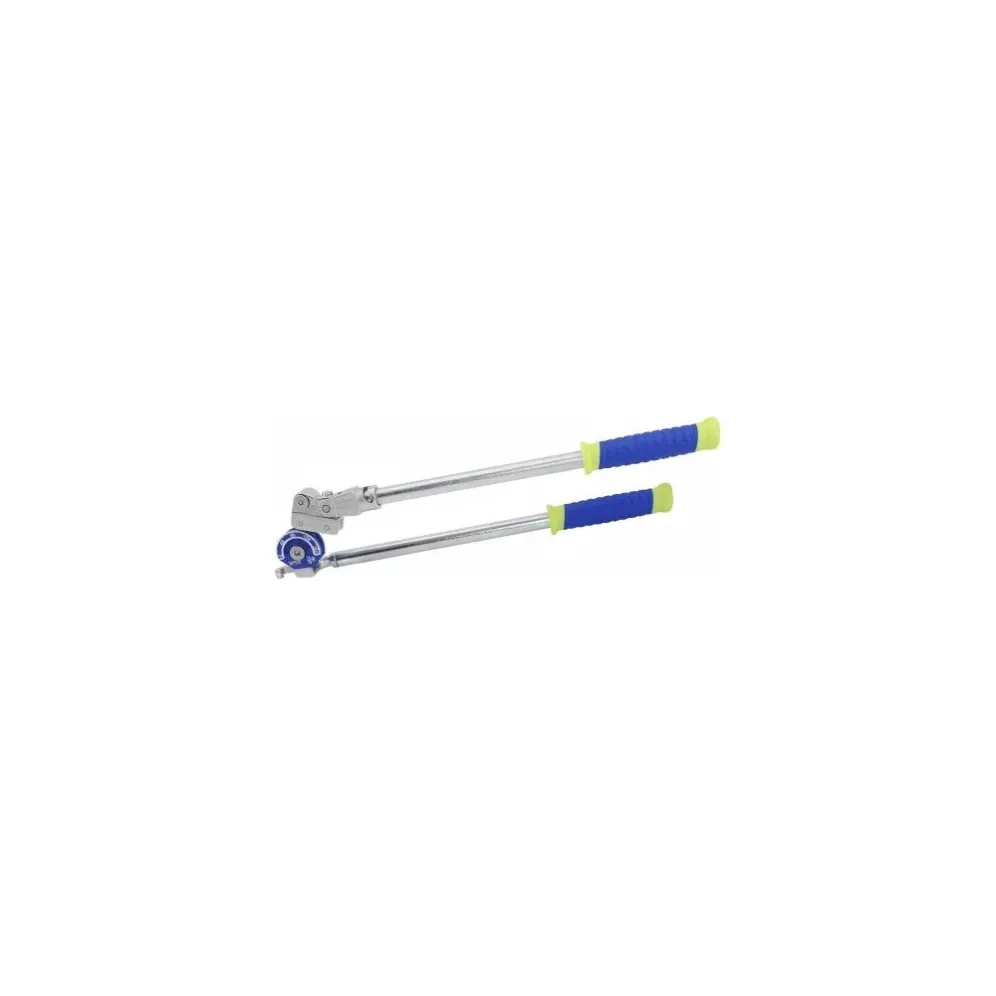
A refrigeration line rarely runs straight from the condensing unit to the evaporator. Somewhere between the two there is a 90-degree turn around a beam, a pair of 45-degree offsets to clear a duct, and a short radius at the coil connection. Each one is a bend the installer has to make on site, with the tube already cut to length and often already flared at one end. This page covers the TB365 manual tube bender set we supply to HVAC wholesalers and refrigeration distributors: four sizes, one lever, and the numbers that decide whether a bend closes cleanly or collapses the wall.
At a glance
- Four sizes: 1/4, 1/2, 5/8 and 7/8 in tube (6, 12, 16, 22 mm)
- Two-stage forming with roller wheels, so the wall is supported through the arc
- Bends up to 180 degrees on copper, aluminium, thin-wall stainless and mild steel
- Cast aluminium shoe with a machined groove matched to each tube diameter
- Sold as a set or as single sizes, with OEM colour and laser marking
Specification
Item No. | Tube size (inch / metric) | Bending radius | Typical job |
|---|---|---|---|
TB365-04 | 1/4 in (6 mm) | 13.8 mm | Instrument lines, gauges, capillary tube |
TB365-08 | 1/2 in (12 mm) | 36.3 mm | HVAC and refrigeration suction and liquid lines |
TB365-10 | 5/8 in (16 mm) | 53.5 mm | Hydraulic return lines, larger split systems |
TB365-14 | 7/8 in (22 mm) | 80.8 mm | Industrial piping, chiller and rack connections |
Radius values are the forming radius of the shoe. Wall thickness limits are covered in the FAQ below, because they are what most RFQs get wrong.
Why the forming method matters more than the size list
A tube bender is not a size; it is a forming method. Pull a copper tube around a single-point former and the outside of the bend stretches while the inside compresses, which is how a tube ends up with a flattened oval section at the apex. A flattened section is not a cosmetic defect — it reduces the internal cross-section exactly where the refrigerant charge is moving fastest, and on a suction line it shows up later as a capacity complaint the installer cannot explain.
The TB365 uses a two-stage form: the shoe pulls the tube around the radius while a pair of roller wheels follows the outside of the bend and holds the wall in contact with the groove. Support on the outside is what keeps the section round. This is also why the tool is heavier than the pressed-steel benders sold at a lower price point, and why it is the version we recommend above 1/2 in.
Matching the size to the line
Installers usually want the smallest bender that will take their largest tube, which is a false economy on the small end. A 1/2 in shoe used on 1/4 in tube leaves the wall unsupported and produces a kink on the first attempt. Size the shoe to the tube, not the other way round.
- 1/4 in (6 mm) — gauge and capillary lines, mini-split connections, tight work inside a casing where the 13.8 mm radius is the reason this size exists.
- 1/2 in (12 mm) — the workhorse. Most residential split-system liquid and suction lines in Asia and Europe, and the size that gets worn out first in a rental fleet.
- 5/8 in (16 mm) — larger split systems, hydraulic returns, and any line where the installer is fighting a 53.5 mm radius against a fixed void.
- 7/8 in (22 mm) — rack and chiller work. Fewer units sold, but the buyer who needs it usually needs it urgently.
If you also stock the lever-type family, the TB364 12 mm / 1/2 in bender covers the single-size case at a lower unit cost. The two are complements, not duplicates: TB365 is the set a distributor stocks, TB364 is the tool an installer keeps in the van.
Bend radius, wall thickness and the limits worth quoting
Minimum bend radius is normally quoted against tube outside diameter. At 1/4 in the TB365 forms to a radius slightly above two diameters, which is tight enough for panel work; at 7/8 in the radius is roughly 3.6 diameters, which is a comfortable industrial bend. What the catalogue does not state, and what we confirm on every RFQ, is the wall thickness of the tube you intend to run.
Thin-wall tube kinks before the shoe finishes its arc, whatever the tool. Annealed copper in a refrigeration temper bends predictably; hard temper does not, and neither does thin-wall stainless without a mandrel. Send the tube specification — outside diameter, wall, temper — and we will tell you honestly whether the standard shoe will do the job or whether the application needs a different tool.
OEM, packing and mixed containers
The set is a straightforward private-label item. Body colour to a Pantone reference, laser-marked logo on the handle, a printed sleeve or a moulded case, and an instruction sheet in the destination language are all available. Carton print, barcode and inner-pack quantity are set per order.
Because the bender set shares a carton footprint with the rest of our copper-tool range, it is normally consolidated with flaring kits, cutters and reamers rather than shipped alone. One mixed container across the tube-working range is the usual pattern for a distributor opening a new line.
Frequently asked questions
Can the TB365 bend stainless steel tube?
Thin-wall annealed stainless, yes, at the larger radii. Heavier wall or hard temper stainless will need a different forming method. Send the wall thickness and we will confirm before you order.
Is the set sold complete or size by size?
Both. Distributors typically take the four-size set for stock and single sizes as replacements. State the mix in the RFQ and we quote per SKU.
What is the minimum order quantity?
It depends on whether the order is our standard black finish or a Pantone body with laser marking. Standard finish has the lower MOQ; private label is quoted on quantity and artwork.
Do you supply spare rollers or shoes?
Yes, as spare parts against an existing order. Tell us the item number and the part so we quote the correct component.
How is the set packed for export?
Each bender in a moulded case or printed sleeve, then a master carton. Carton dimensions and gross weight are confirmed on the quotation because they change with the case option.
Can I see a sample before placing a bulk order?
Yes. Samples are charged and the cost is credited against the bulk order in most cases. We recommend bending a length of your own tube on the sample — that is the only test that matters.
Continue reading
Request a quotation
Send the tube sizes you run, the quantities, the finish and the destination port. We reply with price, MOQ, lead time and sample cost in one message.