Drain Cleaners & Augers
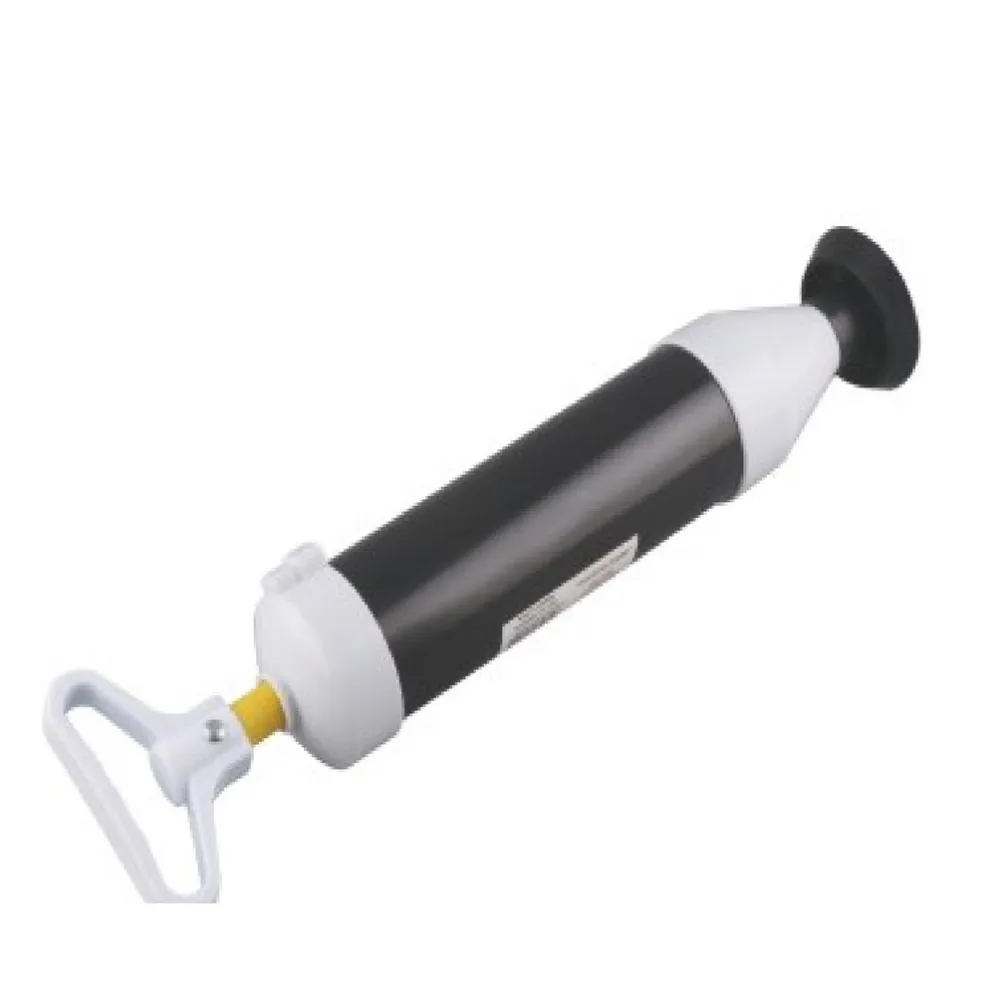
JQ-027A JQ-027B Pump Drain Plunger Two Heads
JQ-027A and JQ-027B hand pump drain plungers with large and small heads for WC pans and sinks. Black or blue body, wholesale from Ningbo.
Specifications
- Models
- JQ-027A (black body), JQ-027B (blue body)
- Heads supplied
- One large head for toilets and larger drains; one small head for sinks and small drains
- Operation
- Piston with suction handle: press down, pull up to draw, push down to release water, repeat
- Body
- Moulded plastic with a separate rubber head
- Metal content
- No cable and no steel in the working parts
- Application
- Soft blockages inside the trap or at the outlet: sinks, basins, baths, showers, urinals, WC pans
- Not for
- Blockages past the trap, roots, hardened grease, scale, main lines
- Packing
- Carton data quoted per item; body colour and carton print available to order
The JQ-027 is a hand pump plunger. Not a bell plunger and not a cable: a moulded body with a suction handle at one end and a rubber head at the other, supplied with two heads so the same tool fits a WC pan and a sink waste. It clears a blockage by moving water under control — pull to draw, push to release — rather than by a single compressed stroke.
Two versions are catalogued. JQ-027A is the black body, JQ-027B the blue. The two are the same tool in two colours, which is the point of offering both: one production line, two customer brands, no second set of tooling.
What is in the box
Two heads, one body
The large head is for toilets and larger drains. The small head is for sinks and small drains. They are not interchangeable in use — the large head will not seat over a 40 mm sink waste, and the small head will not cover a WC outlet. Carrying both in the same package is what makes the tool usable on a whole call rather than on one fixture.
The suction handle
The handle drives a piston inside the body. Pulling it up draws water back through the head; pushing it down drives water forward and releases the pressure. That two-direction control is the difference between this tool and a rubber cup on a wooden stick, where the operator has one stroke and no way to modulate it.
What the catalogue does not say
There is no dimension, weight or stroke figure on the specification sheet for this item — the catalogue describes it by application and by method instead. If you need numbers for a listing or a customs document, ask for them with the sample rather than assuming a value from a similar-looking tool.
Where each head is used
Head | Drain type | How it is worked |
|---|---|---|
Large | WC pan, larger drain outlets | Seat over the outlet, handle fully down, press down then pull up on the suction handle, push down to release, repeat |
Small | Sink, basin, bath and small drain outlets | Same sequence with the smaller cup seated inside the waste |
Either | Shower gully and floor waste | Remove the grate first so the head sits on the outlet rather than on the frame |
Either | Appliance standpipe | Withdraw the hose, then seat the head over the pipe mouth |
Seating matters more than force
The head has to seal. If water escapes round the rim, the piston is moving air and the blockage never sees pressure. On a sink waste that means removing the strainer; on a WC pan it means the head sitting square in the outlet rather than on the sloping porcelain around it.
Working the handle
Place the head over the drain hole with the handle all the way down. Press the plunger down, then pull up on the suction handle, then push down to release the water. Repeat the cycle until the drain runs. The catalogued procedure is deliberately repetitive: several short controlled cycles clear more than one heavy stroke, because each cycle re-establishes the seal.
Why a pump plunger instead of a cup plunger
Draw, not just push
A cup plunger only compresses. Whatever is in the trap is pushed away from the operator, and if it does not move, nothing else happens. A pump plunger draws first: pulling the handle up reverses the flow and lifts the obstruction off the wall of the trap. On a plug of hair and soap that has bonded to the pipe, that reversal is what breaks the bond.
Cleaner in use
Because the pressure is contained inside the body rather than generated by a violent stroke on open water, there is less splash back at the rim. On a domestic call in a fitted bathroom that difference is the reason a service plumber reaches for this rather than a cup.
No cable to mark the fixture
There is no steel anywhere in the tool, so there is nothing to chip enamel or scratch a glazed pan. Where a customer is worried about a new bathroom, this is the tool to start with — and the honest advice is that it clears most domestic fixture blockages without ever needing a cable.
Where it works and where it does not
The cases it handles
Sinks, basins, baths, showers, urinals and WC pans where the obstruction is soft and still inside the trap or immediately behind it. Hair, soap residue, food debris, tissue. These move under a reversing flow and once they move, they travel.
WC pans specifically
The large head is sized for the outlet. This is the fastest first attempt on a blocked toilet, and it costs nothing if it fails. If the water level does not respond after several cycles, stop — the mass is wedged and the next tool is a cable, not a bigger plunger.
What it will not touch
Roots, hardened grease, scale, and anything solid enough to bridge the pipe. It also cannot reach past the trap, because it works by pressure and pressure does not travel round a bend into a blocked branch. Those are cable jobs, and saying so at the point of sale prevents a return.
When the JQ-027 is the wrong choice
A blockage past the trap
If the fixture is clear but the branch is slow, the obstruction is beyond the reach of any plunger. The tool for that is a cable — a 6 mm hand drum auger for a short branch, or a longer auger where the run is longer.
A toilet that stays blocked
A pan that does not respond to a pump plunger almost always has something wedged in the trapway. That is the specific job of the JQ-006 toilet auger, which is built to follow the bend and pull the mass back out.
Kitchen lines with set grease
Grease that has cooled in a kitchen branch has the consistency of candle wax. A plunger will push a channel through it and the sink will run for a week. The correct advice is a cutter head on a cable, and the honest sale is to say the tool will not fix that line.
Main drains and stacks
Nothing hand-held clears a stack. If drains across a property are backing up, the problem is downstream of every fixture and the answer is a machine and probably a camera.
Two colours, one specification
JQ-027A and JQ-027B
Black body and blue body. Same heads, same handle, same method. Nothing in the specification changes between them, and the catalogue lists them as separate item numbers simply because a colour is a customer decision, not an engineering one.
Why that matters commercially
It lets a distributor serve two accounts with one stock line and no tooling cost, and it makes a picking error visible on a shelf. For a buyer setting up a private label, the body colour is one of the few visible branding surfaces on a low-cost tool — the head and the handle are fixed by function, the body is not.
Building the range around it
The natural pairing
This tool is the entry point of a drain-cleaning assortment and the cheapest thing on the shelf. It pairs with a toilet auger for the pans it cannot clear, a hand drum auger for the branches, and a rod set for the drains that need a rigid tool. The drain augers and cleaners range page sets out the whole line.
What to stock alongside
For a trade counter: the JQ-006 toilet auger, the JQ-002 hand drum auger in 4 m and 7.6 m, the JQ-009 range for contractors, and the 9 m drain rod set for outside gullies. The JQ-010 small-bore augers cover the narrow wastes this tool cannot seal against.
Reference material for the counter
Three pages answer the questions this tool generates. The plumbing and drain maintenance tools guide shows the sequence from plunger to cable to machine, and the drum auger versus drain snake comparison stops the naming confusion that loses sales. For condensate lines and other small-bore work, the HVAC condensate drain guide covers where a plunger is the wrong first move.
Further reading on the other site
Our manual air drain blaster and hand pump notes cover the pressure-driven side of manual unblocking, which is a different method from the piston action described here.
Ordering and samples
Send the item numbers, quantity and destination port. Because the catalogue lists this tool by application rather than by dimension, a physical sample is the right way to judge it — the seat of the head and the feel of the piston are the two things that decide whether it sells in your market, and neither is visible in a photograph.
The export team is at [email protected], [email protected] and [email protected], and on WhatsApp at +86 158 6745 7689. Carton data and packing options are quoted per item.
Buyer questions
Is a pump plunger better than a normal plunger?
It gives more control, not more force. The suction stroke pulls the obstruction back before pushing it away, which is what clears a bonded plug of hair and soap. For a soft blockage still in the trap, that makes it more effective than a cup on a stick.
Does the JQ-027 work on toilets?
Yes, with the large head, which is sized for a WC outlet. It is the fastest first attempt on a blocked pan. If the water level does not move after several cycles, the obstruction is wedged and a toilet auger is needed instead.
What is the difference between JQ-027A and JQ-027B?
Body colour. JQ-027A is black and JQ-027B is blue, with the same heads, handle and method. The two item numbers exist so one tool can carry two customer brands.
Why are there no dimensions on the specification?
Because our catalogue describes this item by application and method rather than by dimension. That is a deliberate choice for a tool whose performance depends on the seal rather than on a number. Ask for the figures with a sample if your listing or documentation requires them.
Can it damage a new bathroom suite?
There is no metal in the tool, so there is nothing to chip enamel or scratch glaze. That is one reason it is the right first tool where a customer is protective of a newly fitted bathroom.
Which heads are included?
Both — the large head for toilets and larger drains, and the small head for sinks and small drains. The two are supplied with the tool rather than sold as options, because one without the other limits the tool to half a call.