Drain Augers & Drain Cleaning Tools | Manual, Drum & Drill-Powered | Torchmark
Drain augers from a China factory: JQ-004 hand-turn, JQ-003 manual and drill-powered, and configurable drum augers. Cable sizes, lengths, MOQ and sample terms for distributors.
A drain auger is the one plumbing tool a distributor cannot afford to get wrong: it is bought in volume, it is returned when it kinks, and the complaints almost always trace back to a cable that was too thin or too short for the job. This page is the category overview for the Torchmark drain cleaning range — three model families that cover household, light commercial and maintenance work — with the catalog numbers you need to build an assortment rather than guess at one.
The drain auger range at a glance
Every model below uses a carbon-steel spring cable and works mechanically, without chemicals. The differences that matter to a buyer are the drive method, the cable diameter and the working length.
Model | Drive | Cable dia. | Length | Wire dia. | Listed weight |
|---|---|---|---|---|---|
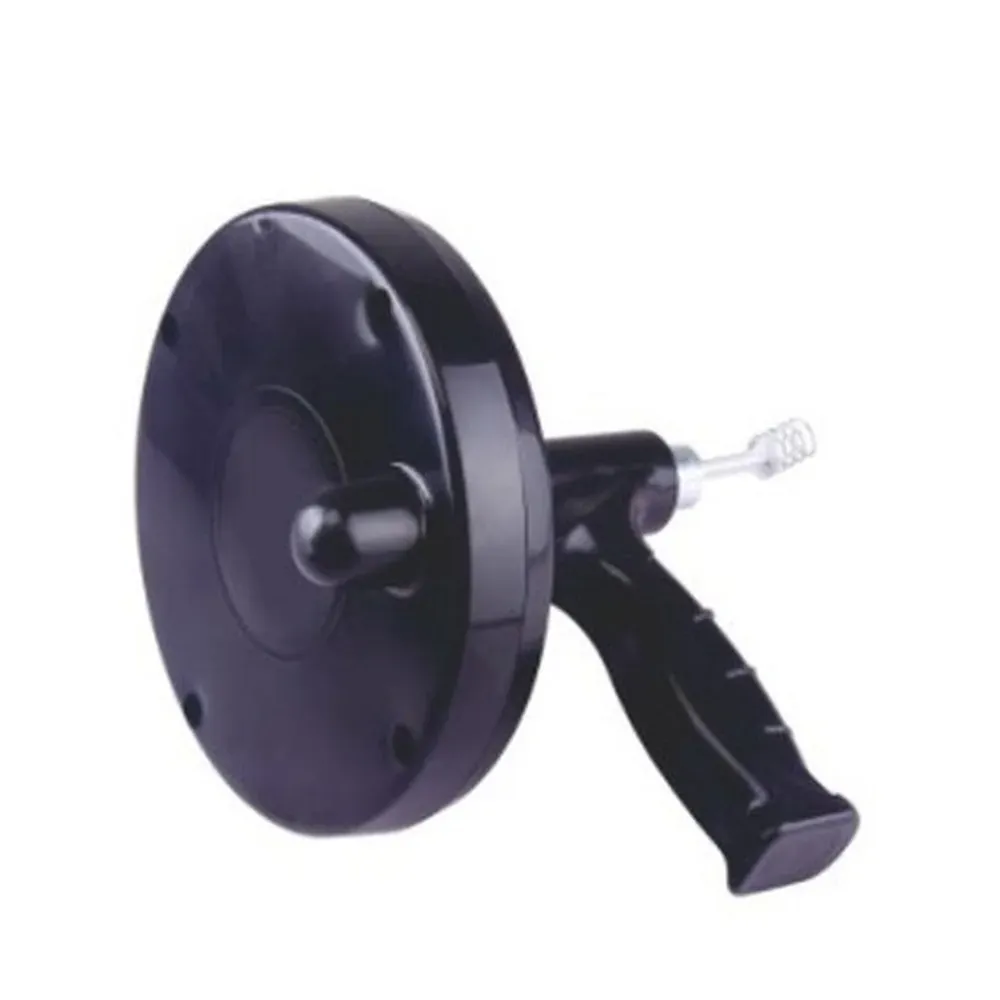
JQ-004-1 | Hand turn | 6 mm | 4.5 m | 1.3 mm | 0.95 kg |
JQ-004-2 | Hand turn | 6 mm | 6 m | 1.3 mm | 1.15 kg |
JQ-003-1 | Hand turn or power drill | 6 mm | 6 m | 1.3 mm | 1.25 kg |
JQ-003-2 | Hand turn or power drill | 6 mm | 7.6 m | 1.3 mm | 1.45 kg |
Drum auger (DA series) | Manual crank, drum feed | 6 mm / 8 mm | 5 m / 7.5 m / 10 m | Configurable | On request |
Source: Torchmark Drain Cleaner Catalog, pages 5 and following. Catalog weights are tool weights — packed carton quantity, carton dimensions and gross shipping weight are quoted separately, because they change with the packaging you choose.
Three decisions that actually decide the model
1. Drive method. If your customers work without power at the point of use, a hand-turn model is the honest answer: the JQ-004 hand-turn drain auger is the entry spec at 4.5 m and 6 m. If the same assortment also serves contractors who already carry a drill, the JQ-003 manual and drill-powered auger covers both modes in one SKU — that is usually the faster-moving of the two in a professional channel.
2. Cable diameter and length. Length sets reach, not capability. A 6 mm cable at 4.5 m clears a sink trap; the same cable at 7.6 m reaches further down a branch line but is harder to control by hand. Our buying guide on drum augers versus drain snakes walks through where each format stops being useful.
3. Whether a drum housing earns its shelf space. A drum keeps the cable contained and clean between calls, which matters when the tool lives in a van rather than a toolbox. The professional manual drum auger is configurable at 6 mm or 8 mm cable and 5 m, 7.5 m or 10 m working length, so one model family covers bathroom, kitchen and light commercial calls.
Where each format fits
- Sink, basin and shower traps (32–40 mm): the most common call. A 6 mm cable at 4.5–6 m is enough; hair and soap matting breaks up mechanically.
- Kitchen lines with grease build-up: reach matters more than diameter. Start at 6 m and confirm the operating instructions before approving.
- Floor drains and light commercial runs: step up to the drum format at 7.5 m or 10 m, where the crank gives controlled feed and retrieval.
- Repeated maintenance contracts: specify drill-powered capability (JQ-003) so crews are not hand-cranking on every call.
What these tools are not for — read before you specify
The catalog states plainly that JQ-003 and JQ-004 are not suitable for toilets, because the cable can mark a ceramic bowl. We would rather lose a line item than take a warranty claim for a scratched suite, so please do not approve a toilet-use claim on these models.
Two more limits worth putting in writing with your customer: cable length does not by itself establish a compatible pipe-diameter range, and drill-speed limits are not specified on the catalog page — do not assume an automatic feed or a maximum rpm. Both are confirmed with the operating instructions during sampling.
Ordering, samples and packaging
Minimum order quantity is 500 pieces. Mixed orders are accepted, but the quantity split by variant has to be stated in the quotation — a mixed order is not a single SKU. Samples are charged, and sample freight is refunded after an order is placed. Typical lead time is 15–45 days from the confirmed order.
Packaging is the part most buyers leave until too late. Decide early whether you need retail cards, colour boxes or plain bulk cartons, and specify label language and branding at quotation stage — the artwork proof is what sets the launch date, not the tooling. Our sourcing FAQ for catalog, factory visits, importing and payment covers the commercial side of a first order.
Quality checks to run before you approve a sample
- Run the cable out to full length and retract it: it should return without a permanent kink or a visible set.
- Check the cable end finish — a rough or burred tip is what scratches fixtures.
- Confirm the handle or crank runs true under load, with no binding at the drum mouth.
- Verify the packing list against the variant numbers (JQ-003-1 versus JQ-003-2), not just the model name.
- Record the approved sample and the written specification before production starts.
Related tools for the same customer
Drain work rarely arrives alone. Distributors building a plumbing assortment usually pair this range with PVC and PPR pipe tools for the supply side of the job, and with HVAC copper pipe tools where the same crew also handles refrigeration work. If you are planning an assortment across trades, the hand tools by application guide shows which tools travel together on the same van.
Frequently asked questions
Can I mix models in one container?
Yes. Mixed orders are available; you state the quantity per variant in the quotation and we confirm allocation. The MOQ of 500 pieces applies to the order, not to each variant.
Do you supply spare cables and heads?
Cables and heads are quoted as spare parts. Ask for them on the same RFQ as the tools so the freight is consolidated.
Is private-label packaging available?
Yes — card artwork, label language, barcode placement and carton marking can all be specified. Send artwork early, because proofing is the longest step in the schedule.
Continue reading
Request a quotation
Send the model and variant numbers, quantities per variant, packaging requirement and destination port. Ask for carton quantity, carton dimensions, gross weight and sample cost in the same quotation so you can cost the landed price in one pass.