Wire Strippers & Crimping Pliers
Eight wire strippers covering 0.2-6 mm2 and four crimping pliers for 0.25-6 mm2 terminals, with carton quantities, dimensions and weights for distributors.
Wire strippers and crimping pliers for professional buyers
TORCHMARK supplies wire strippers and crimping pliers to importers, distributors, wholesalers and private-label buyers. The range covers eight wire strippers with stated stripping capacities from 0.2 to 6 mm2 and four crimping pliers for 0.25-6 mm2 terminals. Every item below carries a published carton quantity, carton dimension and gross/net weight, so a buyer can estimate freight and warehouse space before requesting a quotation.
All figures in this page are taken from the TORCHMARK CJ catalogue, printed pages 30, 33 and 34. Where the catalogue is internally inconsistent, we say so rather than filling the gap.
How to choose a stripping range
Stripping capacity is the first filter. A tool that covers 0.2-6 mm2 replaces several single-size tools in a general catalogue, while a narrow 0.6-2.6 mm2 tool is often preferred for repetitive control-wiring work where the operator wants a light, fast action.
- 0.2-6 mm2 - CJ-WS09866, the widest single-tool coverage in the range.
- 0.6-2.6 mm2 - CJ-WS0824 (6.5 inch) and CJ-WS-0833 (7 inch), both 120 pieces per carton.
- 1.3-3.2 mm2 - CJ-WS0829 (8 inch), 80 pieces per carton.
- 0.75-5.5 mm2 - CJ-WS0830 (9 inch), 60 pieces per carton.
Buyers working to AWG-based specifications should convert and confirm against their own terminal and cable supplier data before placing an order. Millimetre-squared and AWG designations are close but not identical systems, and the acceptable stripping window depends on the actual conductor and insulation, not only on the nominal cross-section. Confirm per order.
Self-adjusting strippers versus adjustable-screw and interchangeable-blade models
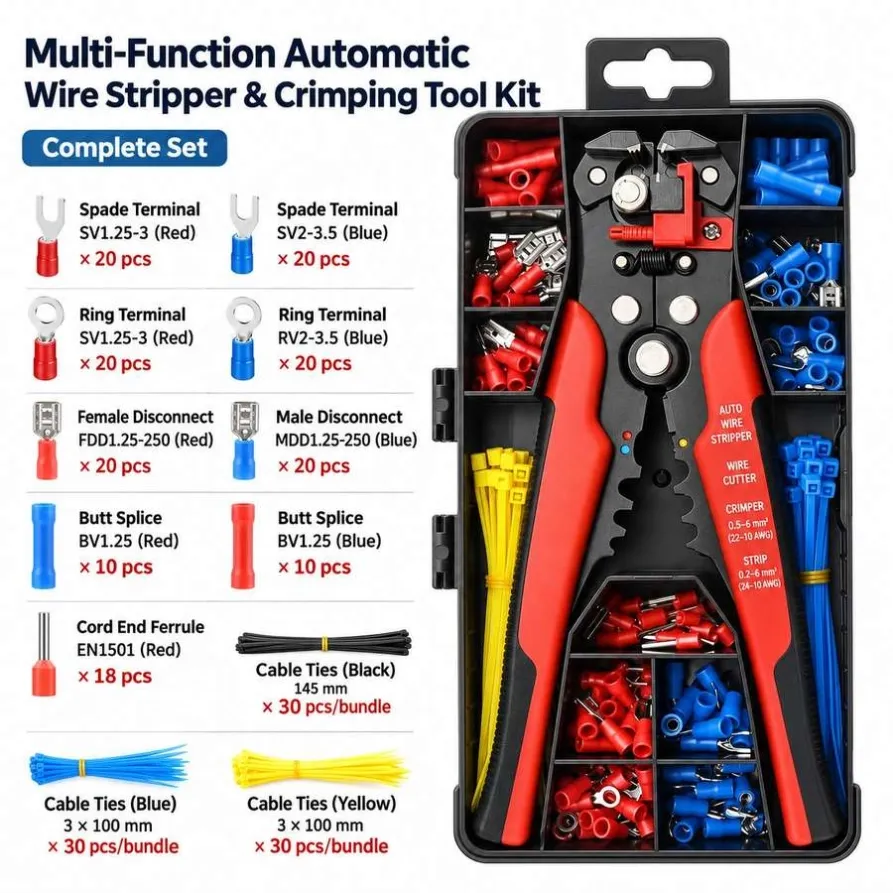
The CJ-WS series uses a self-adjusting stripping action with a rubber protective sleeve on the handle. It suits buyers who want one tool to cover a band of cable sizes without changing settings between conductors.
CJ-PC00822 takes a different approach: an adjustable screw, fixed teeth, a high carbon steel blade and a wire-cutting function, with a high-quality nylon handle and carbon steel handle construction. It is a specification-led tool for buyers who prefer a set position for repetitive work.
CJ-PC00821 uses interchangeable blade sets. Printed page 30 of the TORCHMARK CJ catalogue lists five blade groups for this model - A, B, C, H and N - each with its own stripping profile. Group A is listed as 0.5/1.2/1.6/2.0 mm (AWG 24/16/14/12), group B as 1.0/1.6/2.0/2.6/3.2 mm (AWG 18/14/12/10/8), group C as 1.25/2.0/3.5/5.5/8.0 mm square (AWG 16/14/12/10/8), group H as 1.2/1.6/2.0/2.6/3.2/0.5 mm (AWG 16/14/12/10/8/24) and group N as 0.5/1.2/1.6/2.0/2.6/3.2 mm (AWG 24/16/14/12/10/8). These are the printed catalogue values, reproduced without rounding. Millimetre and AWG designations are close but not identical systems, so confirm the blade group against your own cable samples before placing an order. CJ-PC00821P is the heavy-duty variant with a double-colour plastic handle and a zinc-alloy cast body.
Wire stripper specifications
Item no. | Size | Stripping capacity | Pcs/ctn | Carton (cm) | G.W./N.W. (kg) | Construction (catalogue wording) |
|---|---|---|---|---|---|---|
CJ-PC00821 | 7" | Five interchangeable blade sets A/B/C/H/N with printed capacities (see blade group table below) | 50 | 59x33x28 | 19/17 | High carbon steel blade; alloy aluminium casting; plastic handle; strong spring |
CJ-WS09866 | 8" | 0.2-6 mm2 | 40 | 60x27x21 | 15/14 | High carbon steel blade; carbon steel body; rubber protective sleeve |
CJ-PC00821P | 7" | Heavy duty | 50 | 59x33x28 | 23/21 | High carbon steel blade; double-colour plastic handle; alloy zinc casting body |
CJ-PC00822 | 7" | Adjustable screw, fixed teeth, cuts wire | 50 | 59x27.5x25 | 11.7/9.7 | High carbon steel blade; nylon handle; carbon steel handle |
CJ-WS0824 | 6.5" | 0.6-2.6 mm2 | 120 | 47x39x25 | 18/16 | High carbon steel blade; carbon steel body; rubber protective sleeve |
CJ-WS-0833 | 7" | 0.6-2.6 mm2 | 120 | 39x39x35.5 | 10.5/8.5 | High carbon steel blade; carbon steel body; rubber protective sleeve |
CJ-WS0829 | 8" | 1.3-3.2 mm2 | 80 | 33x31x29 | 15/13 | High carbon steel blade; carbon steel body; rubber protective sleeve |
CJ-WS0830 | 9" | 0.75-5.5 mm2 | 60 | 35x32x29 | 15/13 | High carbon steel blade; carbon steel body; rubber protective sleeve |
CJ-PC00821 blade groups
Blade group | Catalogue spec | AWG as printed |
|---|---|---|
A | 0.5/1.2/1.6/2.0mm | AWG24/16/14/12 |
B | 1.0/1.6/2.0/2.6/3.2mm | AWG18/14/12/10/8 |
C | 1.25/2.0/3.5/5.5/8.0mm square | AWG16/14/12/10/8 |
H | 1.2/1.6/2.0/2.6/3.2/0.5mm | AWG16/14/12/10/8/24 |
N | 0.5/1.2/1.6/2.0/2.6/3.2mm | AWG24/16/14/12/10/8 |
The catalogue prints "mm square" for some groups while the knife-shape diagrams show mm2. We reproduce the wording as printed rather than reconciling the two; confirm the unit with our sales team before issuing your own specification sheet. A complete blade chart also carries groups D, E, F, G and VA, but those are not printed against this model on page 30 - confirm which groups are supplied with your order before copying them into a purchase specification.
Two catalogue notes for buyers: the CJ-WS-0833 code is printed with a hyphen while the other CJ-WS codes on the same page are not; and CJ-WS0829 carries an additional printed line reading "Cut wire 0-35mm2", which does not match the scale of its stated stripping range. We treat that line as unverified and exclude it from our specification. Confirm both points in writing when you raise an RFQ.
Crimping pliers specifications
Item no. | Capacity | Crimp profile | Pcs/ctn | Carton (cm) | G.W./N.W. (kg) | Construction |
|---|---|---|---|---|---|---|
CJ-CP00864 | 0.25-6 mm2 | Quadrilateral | 40 | 51x32x27 | 18/16 | High carbon steel body; double-colour plastic handle |
CJ-CP00864A | 0.25-6 mm2 | Quadrilateral | 40 | 51x32x27 | 18/16 | High carbon steel body; double-colour plastic handle |
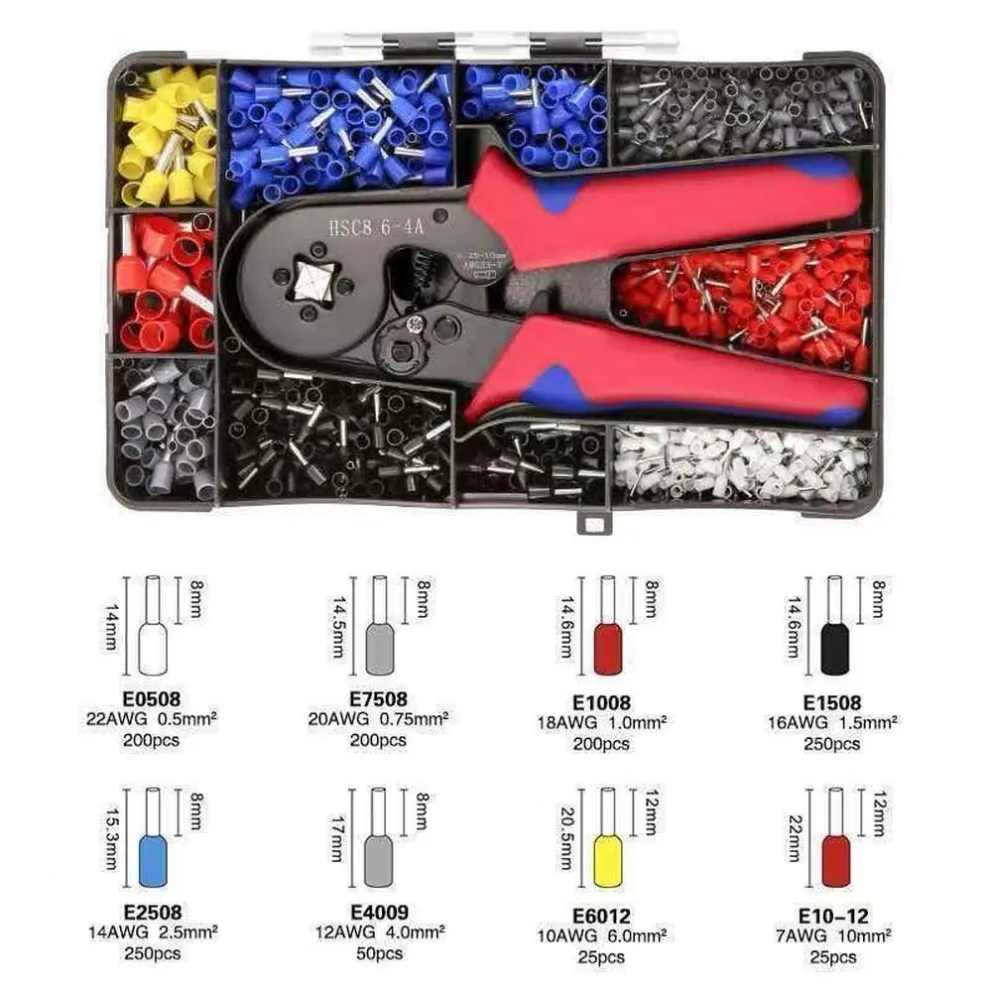
CJ-CP00866B | 0.25-6 mm2 | Hexagonal | 40 | 51x32x27 | 18/16 | High carbon steel body; double-colour plastic handle |
CJ-CP008601 | Not stated | Mini electronic plier | 120 | 47x24x40 | 11/10 | Mini electronic plier |
The CJ-CP00866B heading and its own carton table disagree: the heading reads CJ-CP00866B while the item-number cell beneath it reads TD-CP00866B. We flag it rather than guessing which is correct. CJ-CP008601 has no capacity printed in the catalogue, so we leave that cell empty instead of inferring one.
Quadrilateral versus hexagonal crimp profiles
CJ-CP00864 and CJ-CP00864A produce a quadrilateral crimp; CJ-CP00866B produces a hexagonal crimp. All three are listed at 0.25-6 mm2 and share the same carton quantity, carton size and weight, which means the choice between them is about the finished crimp shape rather than about capacity or freight.
Crimp shape is normally specified by the terminal or connector manufacturer, not by the tool supplier alone. Before ordering, confirm the required profile, die geometry and conductor range against your terminal supplier's specification sheet, and request a sample crimp for approval. We do not state compliance with any external crimping standard on this page.
For broader selection context, see crimping tools: types, sizing and selection, cable crimping tools and specifying self-adjusting ferrule crimpers.
Construction and materials across the range
Across the eight strippers, the catalogue states a high carbon steel blade and a carbon steel body, with a rubber protective sleeve on the self-adjusting models. Handle materials vary by model: standard plastic on CJ-PC00821, double-colour plastic on CJ-PC00821P, and nylon with carbon steel on CJ-PC00822. Body construction also varies, with alloy aluminium casting on CJ-PC00821 and alloy zinc casting on the heavy-duty CJ-PC00821P.
For buyers building a range, these differences matter more than they look on a specification sheet: they drive the feel of the tool, the expected retail tier and the price point a market will accept. Ask for physical samples of the two or three models you plan to list rather than choosing from a table alone.
Incoming inspection checklist for distributors
The following are inspection points a buyer may reasonably include in its own receiving procedure. They describe what to check, not a performance guarantee from the supplier.
- Item number and carton marking match the purchase order, including the CJ-WS-0833 hyphen and the CJ-CP00866B / TD-CP00866B discrepancy.
- Blade edges are free of visible damage and the stripping notches align with the stated capacity band.
- Spring return, pivot action and handle sleeves operate consistently across sampled pieces.
- Test strips on the buyer's own cable confirm that insulation is removed without nicking the conductor.
- For crimping pliers, sample crimps are checked against the terminal supplier's dimensional and pull-test requirements.
- Carton quantity, carton dimension and gross/net weight are verified against the table above before consolidation.
Packaging, carton data and mixed containers
Carton data is published for all twelve items, which makes freight planning possible before a quotation is issued. As an illustration of the arithmetic, CJ-WS0824 measures 47x39x25 cm (0.04582 m3 per carton) at 120 pieces per carton; a 40HQ container at 66 m3 with a 0.87 loading factor works out to roughly 1,253 cartons, or about 150,360 pieces, as a theoretical upper bound. CJ-CP00864 at 0.04406 m3 and 40 pieces per carton gives roughly 1,303 cartons, or about 52,120 pieces.
These are planning figures derived from published carton dimensions, not a loading commitment; palletisation, carton orientation, mixed-SKU consolidation and carrier limits all reduce the realised quantity. For mixed orders, the same carton arithmetic applies to each item in the range. Share your target SKU mix when you request a quotation and the carton plan can be worked through before the order is placed.
Applications across electrical and service channels
Buyers typically place these tools in electrical panel wiring, control cabinet assembly, HVAC control wiring, appliance and equipment repair, low-voltage installation, cable assembly workshops and general industrial MRO catalogues. The stripping capacity bands above map to different points in that list: wider bands for mixed maintenance work, narrower bands for repetitive assembly.
OEM and private-label options
Double-colour handles, handle sleeve colours, cast body finishes and packaging are the visible variables in this range and are the elements most often discussed for private-label programmes. Discuss artwork, carton marking and any documentation requirements with the sales team before sampling. Minimum order quantities, trial-order arrangements, lead times and pricing are confirmed per order; we do not publish fixed figures on a product page. See OEM/ODM services for the process outline.
Request a quotation
Send the item numbers, the quantities you are planning, your target stripping or crimping range, and any packaging requirements to the team through the contact page. If you are still deciding between models, state the cable sizes and terminal types you work with and we will check them against the range above.
Buyer questions
Which stripping range should I stock first?
For a general electrical wholesale catalogue, start with the widest single tool, CJ-WS09866 at 0.2-6 mm2, then add a narrow-band tool such as CJ-WS0824 at 0.6-2.6 mm2 for high-volume repetitive work. This covers both mixed maintenance demand and assembly-line demand without duplicating capacity. Confirm against the cable sizes your market actually uses.
Can I treat mm2 and AWG as the same?
No. They are different designation systems and the conversion is approximate. Use the millimetre-squared figures in our table as the tool-side specification, then confirm the conductor and insulation dimensions with your cable supplier. If your customers order in AWG, ask us to map the intended AWG sizes to the appropriate stripping window before sampling.
What is the difference between CJ-CP00864 and CJ-CP00866B?
They share the same 0.25-6 mm2 capacity, carton quantity, carton size and weight. The difference is the finished crimp: CJ-CP00864 and CJ-CP00864A produce a quadrilateral crimp, while CJ-CP00866B produces a hexagonal crimp. Select the profile required by your terminal supplier and approve a sample crimp before committing to a bulk order.
Can wire strippers and crimping pliers be consolidated in one shipment?
Yes, mixed-range orders are a normal part of this business. Because every item has a published carton dimension and piece count, the consolidation can be planned before the order is placed. Share your target mix and we will work through the carton plan with you. Final quantities depend on the carrier and the loading method.
Are samples available before a bulk order?
Paid samples are part of our standard process for professional buyers. Samples let you check stripping quality on your own cable, verify the crimp profile against your terminals and confirm the handle and packaging finish. Contact the team with the item numbers you want to evaluate and we will advise on the sample arrangement.
What should an RFQ include?
Include the exact item numbers, target quantities, the stripping or crimping range you need, any AWG or terminal references, the required crimp profile where relevant, packaging and artwork requirements, and your destination port. Flagging the two catalogue discrepancies noted above in the RFQ avoids a mismatch between the order and the carton marking.
For a size-by-size comparison of the eight stripping models, see the wire stripper size chart from 0.2 to 6 mm2 with capacity bands, tool length and published carton quantities.
For the printed carton dimensions, piece counts, gross and net weights and the container loading calculation behind this range, see the wire stripper and crimping plier carton data and container loading guide.
Before requesting an offer, work through the wire stripper supplier evaluation and RFQ checklist for the written fields that make two quotations comparable.
Where the choice is between two die shapes, the quadrilateral versus hexagonal crimp profile and terminal compatibility comparison sets out why the finished crimp profile has to be matched to the terminal.