Wire Stripper & Crimping Plier Carton Data and Container Loading for Importers
Published carton dimensions, piece counts and gross/net weights for 12 wire strippers and crimping pliers, with 20GP, 40GP and 40HQ theoretical loading calculations.
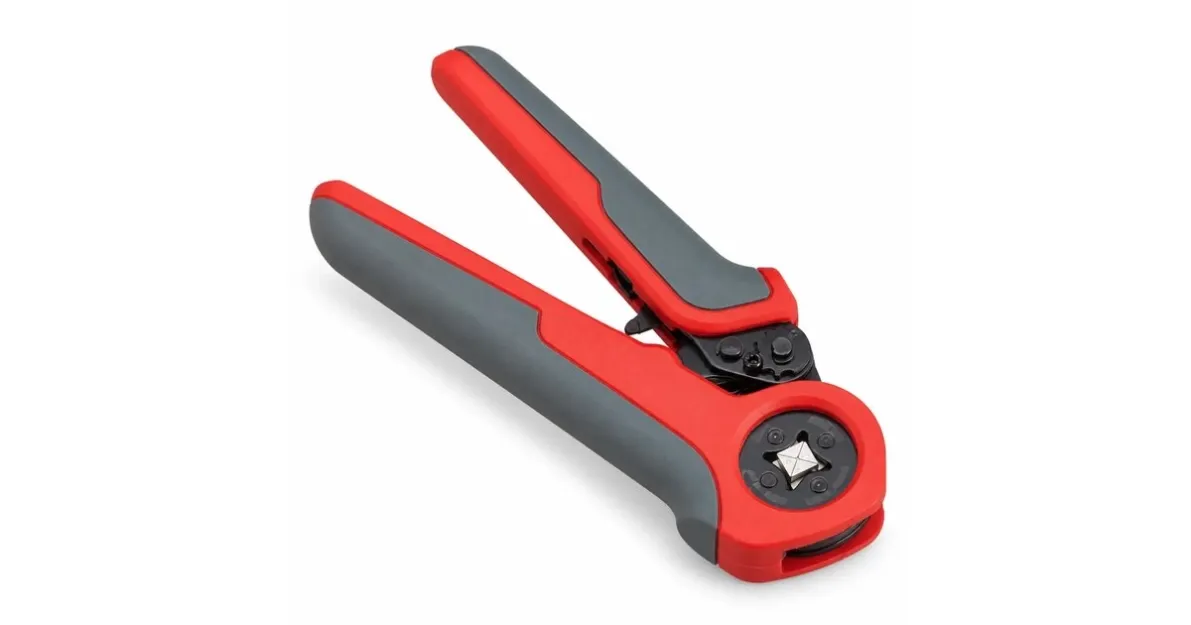
Carton-level data importers actually need before an RFQ
Most hand-tool enquiries stall on the same missing information: how many pieces are in a carton, how large that carton is, and what it weighs. Without those three numbers a buyer cannot estimate freight, cannot compare suppliers on a landed-cost basis and cannot plan a mixed container. This page publishes all three for twelve wire strippers and crimping pliers in the TORCHMARK CJ range, taken directly from printed catalogue pages 30, 33 and 34.
Every figure below is a catalogue value. The container figures are our own arithmetic from those values, and we show the method so any buyer can reproduce it. Full tool-side specification tables are published on the wire strippers and crimping pliers range.
Published carton data
Item no. | Carton (cm) | CBM/carton | Pcs/ctn | G.W./N.W. (kg) |
|---|---|---|---|---|
CJ-PC00821 | 59x33x28 | 0.05452 | 50 | 19/17 |
CJ-WS09866 | 60x27x21 | 0.03402 | 40 | 15/14 |
CJ-PC00821P | 59x33x28 | 0.05452 | 50 | 23/21 |
CJ-PC00822 | 59x27.5x25 | 0.04056 | 50 | 11.7/9.7 |
CJ-WS0824 | 47x39x25 | 0.04582 | 120 | 18/16 |
CJ-WS-0833 | 39x39x35.5 | 0.05400 | 120 | 10.5/8.5 |
CJ-WS0829 | 33x31x29 | 0.02967 | 80 | 15/13 |
CJ-WS0830 | 35x32x29 | 0.03248 | 60 | 15/13 |
CJ-CP00864 | 51x32x27 | 0.04406 | 40 | 18/16 |
CJ-CP00864A | 51x32x27 | 0.04406 | 40 | 18/16 |
CJ-CP00866B | 51x32x27 | 0.04406 | 40 | 18/16 |
CJ-CP008601 | 47x24x40 | 0.04512 | 120 | 11/10 |
CBM per carton is length x width x height in centimetres divided by one million. It is a simple volume calculation, not a declared shipping measurement; confirm packed carton dimensions at the time of order. If you are selecting SKUs before planning the container, the wire stripper size chart from 0.2 to 6 mm2 sets out the capacity bands alongside the tool lengths.
How the container figures are calculated
We use a fixed, published method: usable container volume of 28.5 m3 for a 20GP, 58 m3 for a 40GP and 66 m3 for a 40HQ, multiplied by a loading factor of 0.87, then divided by the CBM per carton. The resulting carton count is multiplied by the piece count per carton.
Theoretical cartons and pieces:
Item no. | 20GP cartons | 20GP pieces | 40GP cartons | 40GP pieces | 40HQ cartons | 40HQ pieces |
|---|---|---|---|---|---|---|
CJ-PC00821 | 454 | 22,700 | 925 | 46,250 | 1,053 | 52,650 |
CJ-WS09866 | 728 | 29,120 | 1,483 | 59,320 | 1,687 | 67,480 |
CJ-PC00821P | 454 | 22,700 | 925 | 46,250 | 1,053 | 52,650 |
CJ-PC00822 | 611 | 30,550 | 1,244 | 62,200 | 1,415 | 70,750 |
CJ-WS0824 | 541 | 64,920 | 1,101 | 132,120 | 1,253 | 150,360 |
CJ-WS-0833 | 459 | 55,080 | 934 | 112,080 | 1,063 | 127,560 |
CJ-WS0829 | 835 | 66,800 | 1,700 | 136,000 | 1,935 | 154,800 |
CJ-WS0830 | 763 | 45,780 | 1,553 | 93,180 | 1,767 | 106,020 |
CJ-CP00864 | 562 | 22,480 | 1,145 | 45,800 | 1,303 | 52,120 |
CJ-CP00864A | 562 | 22,480 | 1,145 | 45,800 | 1,303 | 52,120 |
CJ-CP00866B | 562 | 22,480 | 1,145 | 45,800 | 1,303 | 52,120 |
CJ-CP008601 | 549 | 65,880 | 1,118 | 134,160 | 1,272 | 152,640 |
These are theoretical upper bounds for planning only. They are not a loading commitment. Palletisation, carton orientation, weight limits, mixed-SKU stacking, dunnage and carrier rules all reduce the realised figure. Where gross weight is high relative to volume, weight will govern before space does.
What the numbers change in a mixed order
Two items with identical piece counts can behave very differently in a container. CJ-WS0824 and CJ-WS-0833 both pack 120 pieces per carton, but at 0.04582 and 0.05400 m3 respectively the first yields roughly 1,253 cartons in a 40HQ against roughly 1,063 for the second - a gap of about 22,800 pieces on a full-container plan.
Similarly, CJ-PC00821 and CJ-PC00821P share the same carton dimensions and 50-piece count, yet their gross weights differ (19/17 kg versus 23/21 kg). A buyer consolidating heavy cast-body tools with light self-adjusting strippers should check both the volume and weight totals.
For a mixed SKU order, send the target mix and we will work from the same carton table. Do not simply add the single-SKU maxima together; mixed cartons of different footprints do not stack at the same efficiency. Where the order includes crimping pliers, the quadrilateral and hexagonal crimp profile comparison explains why two tools with the same carton data may still not be interchangeable.
Data quality notes
The catalogue contains three points a careful buyer should confirm in writing. The CJ-WS-0833 code is printed with a hyphen while other CJ-WS codes on the same page are not. CJ-WS0829 shows an additional line, "Cut wire 0-35mm2", that does not match the scale of its stated stripping range; we exclude it as unverified. And the CJ-CP00866B heading is followed by a carton table whose item-number cell reads TD-CP00866B. Flag all three on the purchase order so the carton marking and the invoice refer to the same SKU.
The supplier evaluation and RFQ checklist turns these notes into a written confirmation step before the bulk order.
From carton plan to enquiry
Once the mix is settled, an RFQ should carry the exact item numbers, quantities per SKU, the required crimp profile where applicable, packaging and artwork requirements, and the destination port. Samples are available for evaluation before a bulk order; minimum order quantities, trial-order arrangements, lead times and pricing are confirmed per order rather than published as fixed figures. Our B2B sourcing FAQ and OEM/ODM services cover the wider ordering process. Send the carton plan with your enquiry through the contact page.