Buying Guides
Specifying Self-Adjusting Ferrule Crimpers
A B2B checklist for selecting ferrule crimpers by terminal range, crimp profile, ratchet control, test consistency and OEM packaging.
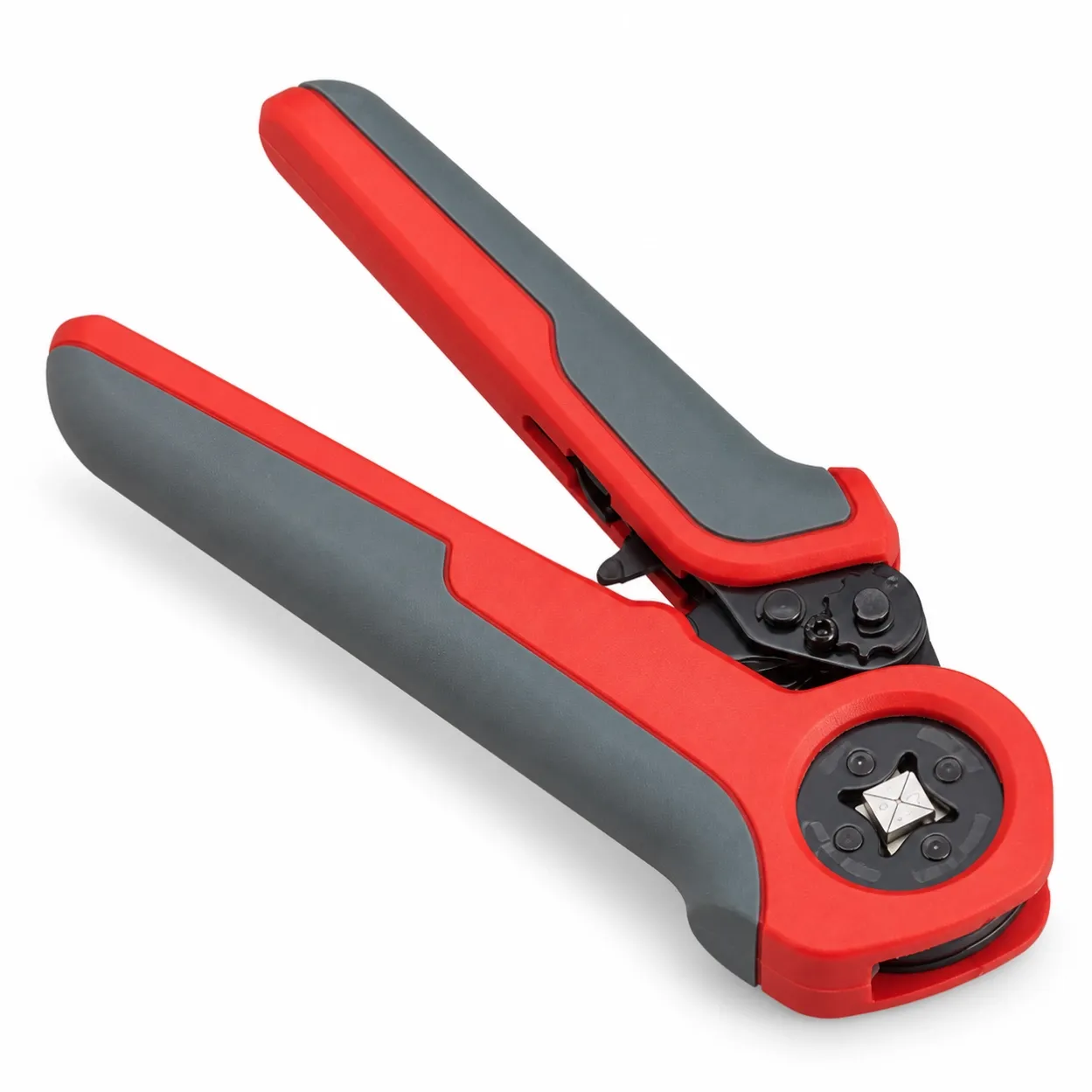
How to Specify Self-Adjusting Ferrule Crimping Pliers
A ferrule crimper must deliver consistent compression across the stated wire range. For electrical-tool distributors and private-label buyers, terminal compatibility, crimp geometry, ratchet control and test repeatability matter more than appearance alone.
- Define the Terminal and Wire Range Confirm whether the tool is for insulated or non-insulated ferrules and record both mm² and AWG requirements. The WXC8 6-4Pro covers 0.25-10 mm² / AWG 23-7, which suits many panel-building and maintenance applications.
- Choose the Crimp Profile Square crimping creates four-sided compression and is widely used for ferrules entering terminal blocks. Buyers should match the profile to the end-user market and electrical standard.
- Check Self-Adjustment and Release The mechanism should automatically adapt to ferrule size while a releasable force lock allows recovery from incorrect positioning. Test several terminal sizes rather than approving only one sample.
- Evaluate Ergonomics and Service Life Confirm handle comfort, operating force, jaw alignment, return action and cycle-test results. Compact length and controlled weight matter to installers who use the tool throughout the day.
- Specify OEM and QC Requirements Define logo position, barcode, color box or blister pack, instruction language, inspection sample size and acceptable crimp-test method before production.
RFQ Checklist
• Terminal type and wire range
• Required crimp profile
• Order quantity and destination market
• Packaging and private-label requirements
• Sample and inspection requirements
Related product: WXC8 6-4Pro Mini Self-Adjusting Crimping Pliers
Contact: https://www.nbtorchmark.com/contact-us
ABOUT THE AUTHOR
Alisa Xu — Product Manager, Ningbo Torchmark Hardware Co., Ltd.
Alisa supports international distributors, importers and private-label buyers with product selection, samples, packaging and export-ready tool programs.
LinkedIn: https://www.linkedin.com/in/alisasourcing/
Order terms: MOQ 500; mixed orders available, with model mix confirmed before ordering. Samples are charged; sample shipping is refunded after an order is placed. Typical lead time: 15–45 days, subject to agreed order details. Author contact: Alisa Xu, Product Manager, 0086-13429254575. Confirm ferrule and terminal-block compatibility before ordering.
View WXC8 6-4Pro ferrule crimper specificationsWhy the capacity figure alone does not close a ferrule crimper order
The five checks above cover the tool. What they do not cover is the part of the enquiry that actually decides margin: the ferrule system the tool will be sold against. A distributor who imports a self-adjusting crimper by capacity alone tends to discover the mismatch after the first container lands, when a panel builder reports that the crimp passes a pull test but will not seat in a specific terminal block.
Self-adjusting matters here because it removes one variable and keeps another. The mechanism adapts to the ferrule cross-section, so an operator does not need to select a die position. It does not adapt to sleeve geometry. Two 4 mm² ferrules from different makers can differ in barrel length and wall thickness by enough to change the finished crimp height. That is why the sample approval step in the checklist should always be run on the exact ferrule brand your market buys, not on a generic sample.
Specification summary for RFQ use
Copy this block into your enquiry so every supplier quotes against the same scope. Anything left blank becomes a place where quotations stop being comparable.
Parameter | What to state in the enquiry |
|---|---|
Crimping capacity | 0.25–10 mm² (AWG 23–7), as built on the WXC8 6-4Pro |
Ferrule type | Insulated, non-insulated, or twin-entry — state which |
Crimp profile | Square (four-sided compression) required, or other |
Adjustment | Self-adjusting; confirm release mechanism present |
Ferrule brand for sample approval | Name the brand and part number |
Acceptance test | Pull-test value and method, or cross-section inspection |
Packaging | Colour box, blister, or bulk; barcode type; logo position |
Cycle life claim | State the number of cycles you need the tool to survive |
Full dimensional data and the current model configuration are listed on the WXC8 6-4Pro self-adjusting crimping pliers page. If your range extends beyond 10 mm², the hydraulic route described in our hydraulic crimping tool sizing guide is the correct comparison rather than a larger hand tool.
Choosing between a hand ferrule crimper and a hydraulic tool
Where a hand crimper is the right answer
Control-cabinet assembly, field service kits and electrical wholesale sets are dominated by 0.25–10 mm² work. In that band a self-adjusting hand tool is faster than a hydraulic head because there is no die change and no pump stroke. It also travels in a tool belt, which matters for installers.
Where the hand tool stops being economical
Once the work moves into larger lugs, or into a production cell running the same size all day, cycle force becomes the constraint. Operators fatigue, crimp height drifts and consistency suffers. That is the point to move to a hydraulic or ratchet tool and to specify dies per size. Our crimping tools range covers both branches, and the hydraulic crimping tools page shows where the hand range ends.
Four specification mistakes that cause rejected shipments
Assuming AWG and mm² are interchangeable at the boundary
AWG 23–7 covers a stated range, but the top of an AWG band and the top of a mm² band are not the same conductor. If your catalogue lists both, confirm the tool on the largest conductor in each system separately.
Specifying “square crimp” without naming the standard
Square describes a profile, not a tolerance. Without an acceptance criterion there is no way to reject a batch that looks right and measures wrong.
Ordering before the ferrule sample is approved
Self-adjusting jaws compensate for size, not for sleeve wall thickness. Approve against the real ferrule first.
Leaving packaging undefined until production
Blister tooling, colour-box print and barcode placement all have lead times that run after tool production, not in parallel. Undefined packaging is the most common cause of a shipment that is otherwise on time.
Quality checks before shipment
Crimp height and cross-section
Agree a crimp height per size, or agree to a cross-section inspection on cut samples. One of the two must be written into the order, because visual inspection will not catch a void.
Jaw alignment and return action
Check that the jaws meet squarely across the full width and that the return spring completes the stroke. A tool that releases only after a manual nudge will be reported as a fault in the field even if the crimp measures correctly.
Pull test on the agreed ferrule
Run the pull test on the ferrule brand named in the enquiry, at the smallest and largest cross-section in the range, not only in the middle.
Packaging, labelling and OEM options
Retail formats
Blister packs suit peg-board electrical wholesale; colour boxes suit catalogues and e-commerce; bulk cartons suit industrial supply. State the format in the RFQ so packaging cost appears in the same quotation as the tools.
Private label scope
Logo position, instruction language, barcode symbology and spare-part labelling are all decided before production. Send artwork with the enquiry rather than after sample approval, so the printed components are ready when the tools are.
MOQ, lead time and landed cost
What actually sets the unit price
On this category the drivers are jaw steel specification, handle construction, packaging format and quantity. Packaging usually moves the price more than buyers expect, which is another reason to define it early.
Planning the first container
First orders commonly combine one hand crimper with accessories and a second size, because the freight cost of a part container is disproportionate. Ask for a mixed first shipment and consolidate on the second.
Frequently asked questions
Can one self-adjusting tool really cover 0.25–10 mm²?
It covers the range, but you should still approve a sample on your own ferrule brand, because sleeve wall thickness varies between makers and affects finished crimp height.
Does the tool need die changes?
No. The mechanism adapts to the cross-section automatically. You still select the correct ferrule size, and a release mechanism lets you recover from an incorrect placement.
Is a square crimp acceptable for all terminal blocks?
Square is widely preferred for terminal-block entry, but confirm against the terminal manufacturer's specification before you commit, especially on spring-clamp designs.
Can we get our own brand and barcode?
Yes. Logo placement, instruction language, barcode symbology and packaging format are all specified before production. Send artwork with the RFQ so cost is quoted together.
What should the acceptance test be?
Either a stated pull-test value per size or a cross-section inspection on cut samples. Choose one and write it into the order; visual checks alone will not catch internal voids.
Do you supply spare parts?
Wear parts and replacement components are handled through our accessories and spare parts route. Ask for the spare-part list with the quotation so it can be listed alongside the tool.
Where to go next
- WXC8 6-4Pro self-adjusting crimping pliers — capacity, profile and configuration
- Crimping tools range — hand, ratchet and hydraulic branches
- Hydraulic crimping tools — where the hand range ends
- Hydraulic crimping tool sizing guide — sizing above 10 mm²
- Cable crimping tools by application — matching tool to conductor and terminal
- Sourcing FAQ — catalogue, factory audit, import and payment
Request a quote
Send the ferrule sizes, the terminal systems you sell against, quantities, packaging format and destination port. We will return price, MOQ, lead time and sample cost in one reply.
When building a full electrical tool range, also check the wire strippers and stripping capacity chart for the matching stripping capacity bands.