Oct 26, 2026
Drain Auger Tips: 12 Head Types Explained
Twelve drain auger heads, JQ-01 to JQ-12: which shape grabs hair, which bores waste and which clears grease, plus the cable each fits.
Twelve heads, and why the code number tells you nothing
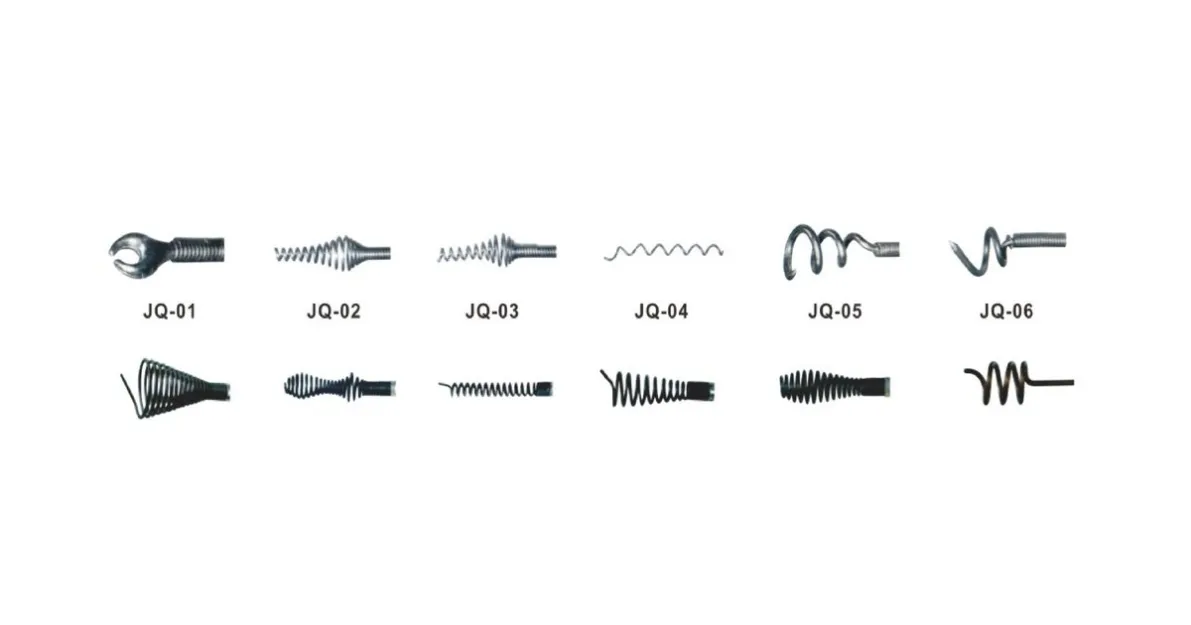
Every manual drain auger in our range ends in a head, and a distributor who stocks augers eventually gets asked which head does what. The catalogue lists twelve of them, JQ-01 through JQ-12, and the number is only a part code. The shape is the whole story.
Code | Head shape | What that shape is normally reached for | Where it lets you down |
JQ-01 | Bulb or ball head on a short shank | Pushing through a soft blockage and following the bend of a trap | Cannot grab anything, so it pushes rather than removes |
JQ-02 | Stepped cone with ring grooves | Centring in an open pipe and pushing soft sludge | Slips on hard scale and on grease that has set |
JQ-03 | Slim stepped cone, narrow profile | Small branch lines where a wide head will not pass | Too small to carry a heavy rag out |
JQ-04 | Formed wave on the cable end, no head | Reaching past the trap without a head to snag | No grip at all, useful only for probing |
JQ-05 | Open spiral with a gap | Hooking hair and textile out of a basin or bath waste | Unwinds under heavy torque |
JQ-06 | Angled hook on a short shank | Reaching round a bend to pull a plug or a rag back | Will not travel down a straight run of any length |
JQ-07 | Funnel cone, wide mouth | Pushing a channel through a soft deposit | Passes grease instead of clearing it |
JQ-08 | Stepped cone with a coil behind it | Toilet outlets and pan connectors where the bore changes | Needs a straight approach to seat |
JQ-09 | Slim spring on a straight shank | Following a long sweep without loading the cable | Little cutting action |
JQ-10 | Open loop with a coil body | Getting behind a partially open flap or a badly aligned joint | Snags on rough cast iron |
JQ-11 | Tapered spring, wide to narrow | Working down a reducing line | The wide end binds in a 50 mm trap |
JQ-12 | Double spring head | Heavier sludge in a floor drain or a gully | Too stiff for anything under 50 mm |
Shape decides the job, not the size
A 9 mm cable with a hook head and a 9 mm cable with a cone head are the same tool with two different jobs. Selling the cable and forgetting the head is how a customer ends up with an auger that "does not work".
Grab, push or centre
Almost every head on the chart does one of three things. Hooks and open spirals grab. Cones and bulbs push or centre. Springs follow the pipe. Once you sort the twelve into those three groups, the choice becomes obvious.
The charts in the catalogue and the charts online
Most suppliers show the twelve heads as a picture with no explanation. That picture is the most common thing a buyer forwards to us with the question "which one?". It is worth having an answer ready.
Pairing a head with a cable
The head is only half the specification. The cable decides reach, and the two have to be ordered together.
What the cable range actually covers
Our JQ-009A series runs from 7 mm to 10 mm cable in 3 m, 5 m, 7 m and 10 m lengths, with line diameters from 1.4 mm to 2.0 mm. The table below is the full variant list rather than a summary, because buyers order against the item number.
Item | Cable dia | Length | Line dia | Weight |
JQ-009A-1 | 7 mm | 3 m | 1.4 mm | 0.45 kg |
JQ-009A-2 | 7 mm | 5 m | 1.4 mm | 0.75 kg |
JQ-009A-3 | 7 mm | 10 m | 1.4 mm | 1.5 kg |
JQ-009A-4 | 8 mm | 3 m | 1.6 mm | 0.6 kg |
JQ-009A-5 | 8 mm | 5 m | 1.6 mm | 1 kg |
JQ-009A-6 | 8 mm | 7 m | 1.6 mm | 1.4 kg |
JQ-009A-7 | 8 mm | 10 m | 1.7 mm | 2 kg |
JQ-009A-8 | 9 mm | 3 m | 1.7 mm | 0.69 kg |
JQ-009A-9 | 9 mm | 5 m | 1.7 mm | 1.15 kg |
JQ-009A-10 | 9 mm | 7 m | 1.7 mm | 1.61 kg |
JQ-009A-11 | 9 mm | 10 m | 1.7 mm | 2.3 kg |
JQ-009A-12 | 10 mm | 5 m | 1.7 or 2.0 mm | 1.4 or 1.55 kg |
JQ-009A-13 | 10 mm | 10 m | 1.7 or 2.0 mm | 2.8 or 3.1 kg |
Weight is the number that decides the carton
A 10 m 10 mm auger weighs 3.1 kg before packing. Ten of those in a master carton is a two-person lift, and that changes how you quote freight. Ordering by length alone hides this.
Confirm the head thread before mixing
Heads fit a specific cable end. Before promising a customer that any head fits any auger, confirm the shank against the cable you actually stock. This is the single most common mismatch we are asked about.
Choosing a head from the blockage, not from the tool
Work backwards from what is in the pipe. It is faster than guessing from the head chart.
Hair and textile
Nothing pushes hair out of a basin waste. An open spiral or a hook grabs it. A bulb head only compacts it further down.
Paper, wipes and food waste
These respond to working into the mass rather than hooking it. A stepped cone or a slim spring works its way in and lets the material break up.
Grease
Grease in a kitchen line does not hook and does not break up. A funnel cone pushes a channel through, which restores flow without clearing the deposit. Tell the customer that plainly.
Scale and hard deposits
A hand auger is the wrong tool. Scale needs a machine with a cutting head, and recommending otherwise wastes a service call.
Nothing visible at all
Start with a bulb head or a plain cable end. Probing establishes where the restriction is before any head gets committed to it.
What to stock as a distributor
The head range is small and cheap to carry, and it is the reason an auger sale turns into a repeat order.
Three heads cover most callbacks
Hook, cone and spring head. Those three answer the majority of "which one do I need" questions, and they fit in the same small parts bin.
Heads sell as accessories
A customer who buys one auger and loses a head will buy a replacement head before buying a second auger. Stocking them is what keeps the account live between tool orders.
Spare cable is the other half
Cable kinks before the head wears out. Carrying the spare cable range next to the heads is what turns a one-off sale into a maintenance account.
When a tip is the wrong thing to sell
There are situations where a different head is not the answer, and saying so protects the relationship.
Blockage beyond the cable's reach
A 5 m cable in a 12 m run will not reach. Selling a different head does not fix a length problem; the 9 m drain rod set or a longer cable is the honest recommendation.
Roots in the line
A hand auger will not clear roots. That needs a machine and a cutting head, and the customer should hear it before they buy.
A collapsed or offset pipe
If the cable stops dead at the same point twice, the line is damaged rather than blocked. A camera survey is the next step, not another head.
Toilet pans with a deep trap
A short basin auger will not negotiate a toilet trap. A purpose-made toilet auger with a vinyl guard is the correct tool, and it protects the porcelain as well.
Questions buyers ask about auger heads
How many tip types do you produce?
Twelve, coded JQ-01 to JQ-12. They cover grabbing, boring, pushing and centring heads, and they are supplied as spare parts as well as fitted to new augers.
Does one head fit every cable?
No. Heads fit a specific cable end, so confirm the shank against the cable you stock before promising interchangeability across the range.
Which head clears hair?
An open spiral or an angled hook. Hair has to be grabbed and pulled back; a bulb or cone head only pushes it further into the line.
Which head should I stock first?
Hook, cone and spring head. Those three answer most end-user questions and take up very little shelf space in a small parts bin.
Can I order heads without the auger?
Yes. Heads and cables are both supplied separately, which is how distributors keep an installed base of augers working without a new tool order.
What is the lead time on a mixed head order?
Typically 15 to 45 days depending on the mix and the packing. Send the item numbers and quantities and we will confirm the schedule with the quotation.
Request a quotation for heads or complete augers
Send the item numbers, quantities, packing and destination and we will return carton data and a quotation. Email amy@longrunhardware.com, alisa@longrunhardware.com or akira@longrunhardware.com, or message us on WhatsApp at +86 158 6745 7689. Product Manager Alisa Xu handles this range. Start from the drain auger range, or go straight to the JQ-003 manual and drill-powered auger, the JQ-004 hand-turn auger and the manual drum auger. Cable sizing is set out in the cable size chart, tool selection in the drum auger versus drain snake guide and the manual versus drill-powered guide, and routine maintenance in the plumbing drain maintenance guide and the condensate drain guide. The same range is listed for the trade on our Longrun drain augers page.Small-diameter augers for basin and long thin runs
Where the cable has to be small and the run is long, the JQ-010A and JQ-010B hand drain auger covers 5 mm and 6 mm cable from 1.5 m to 10 m, with the 10 m 6 mm item weighing 1.25 kg. It is the tool for basin wastes, urinal outlets and condensate runs that a drum machine cannot enter, and both handle colours share one specification.The 7 mm to 10 mm professional range
Where the job needs a heavier cable or a longer reach than a 5 mm auger can give, the JQ-009A, JQ-009B and JQ-009C drain augers run 7 mm to 10 mm cable in 3 m, 5 m, 7 m and 10 m, with 13 item numbers per version and a weight span of 0.45 kg to 3.1 kg. The three versions share one specification table, so the choice between them is a packaging and channel decision rather than a performance one.