Buying Guides
300 cc vs 500 cc Oil Cans: Buyer's Guide
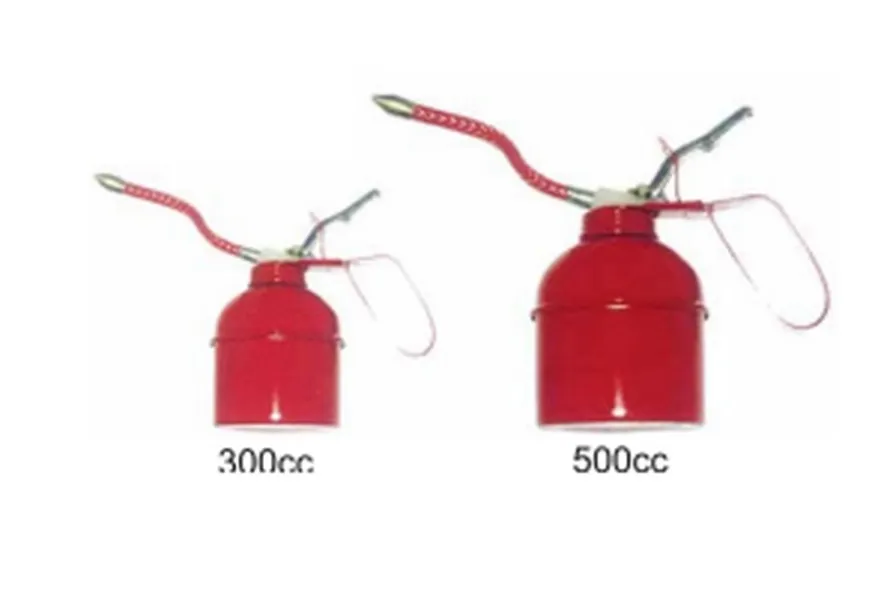
Choose 300 cc or 500 cc oil cans by handling and refill routine, not unit price. CJ-001 is 300 cc (60 pcs/carton), CJ-002 is 500 cc; capacity does not set pump pressure or fluid compatibility.
300 cc vs 500 cc Oil Cans: A Distributor Selection Guide
Compare handling requirements, refill routines and packaging before choosing a capacity. CJ-001 and CJ-002 are American-style manual oil cans with a plastic pump. Capacity alone does not establish pump pressure, fluid compatibility or durability.
Catalog comparison
CJ-001: 300 cc; 60 pieces/carton; gross weight 12 kg/carton; carton dimensions 48 × 38 × 44 cm.
CJ-002: 500 cc; 60 pieces/carton; gross weight 13 kg/carton; carton dimensions 48 × 43 × 49 cm.
Calculated carton volumes are 0.080256 m³ and 0.101136 m³. The CJ-002 carton occupies about 26% more volume, but freight charges do not necessarily change by the same percentage. Confirm final packing and shipping terms. These are catalog calculations, not shipment measurements.
Which capacity should you evaluate?
Start with the customer’s handling, storage and refill requirements. A buyer preferring lower fill volume can evaluate 300 cc; a buyer needing more nominal capacity can compare 500 cc. For mixed customer groups, evaluate both samples and use your sales history to decide the assortment. No best-selling size or universal performance advantage is claimed here.
Sample checklist
Identify the intended lubricant and operating conditions. Record the model, spout configuration, pump operation, dispensing control and leakage observations under your agreed handling and storage conditions. Ask for body and seal information when relevant. Agree acceptance criteria before placing the bulk order.
Consult the lubricant supplier’s product and safety data sheets. Mobil’s official FAQ explains where its documentation is available:
https://www.mobil.com/en/sap/business/lubricant-expertise/tips-and-tricks/faqs/products-faqsThis is a documentation reference, not an approval of oil-can compatibility.
Is 60 pieces the minimum order?
It is the catalog packing quantity. MOQ and mixed-model packing require quotation confirmation.
Does 500 cc mean greater pump pressure?
No pressure rating is established by these capacity specifications.
Can metal-pump and plastic-pump models be substituted?
Do not assume equivalence from matching capacity. Compare exact configurations and evaluate the intended fluid and application.
Request a useful quotation
Send the model, quantity per model, intended lubricant, destination, packaging requirements and sample needs. Mixed orders are welcome. Samples are charged; sample shipping costs are refunded after an order is placed. Typical lead time is 15–45 days. Confirm the order quantity, packing and customization requirements in your quotation.
Contact: contact usEmail: Related category: oil cans and lubrication toolsAbout the author: Alisa Xu | Product Manager | Ningbo Torchmark Hardware Co., Ltd.
Phone: 0086-13429254575
Product figures are based on the company oil-can catalog.What changes when you move from 300 cc to 500 cc
The comparison above covers capacity in the hand. What decides whether 300 cc or 500 cc belongs in your range is not the fill volume — it is what the extra volume does to the carton, the freight and the shelf.
Two stock models show the effect cleanly. CJ-001 is an American-style oil can with a plastic pump at 300 cc, packed 60 pieces to a carton measuring 48 × 38 × 44 cm. CJ-002 is the same style at 500 cc, also 60 pieces, in a carton measuring 48 × 43 × 49 cm. Same piece count, larger carton. The volume difference is roughly a quarter more cubic capacity per shipment for two-thirds more product per can — but only if the price point and the end-use support it.
300 cc vs 500 cc at a glance
Parameter | 300 cc (CJ-001) | 500 cc (CJ-002) |
|---|---|---|
Style | American, plastic pump | American, plastic pump |
Capacity | 300 cc | 500 cc |
Pieces per carton | 60 | 60 |
Carton dimensions | 48 × 38 × 44 cm | 48 × 43 × 49 cm |
Volume shipped per carton | 18.0 litres of oil capacity | 30.0 litres of oil capacity |
Typical buyer | Tool kits, machine-tool accessory, service vans | Workshop bench, maintenance stores, fleet garages |
Price positioning | Entry / promotional | Mid, volume-perceived |
The full grid, including 150 cc, 250 cc, 350 cc and 400 cc options across 45 stock models, is on the pump oil cans collection page. Carton sizes vary by model, so always take the freight figure from the exact SKU you intend to order.
Choosing capacity by end use, not by price
Where 300 cc sells better
Service vans, field kits and machine-tool accessory packs. A technician who carries the can wants weight low and balance good when the can is half full. 300 cc also works as the promotional size in a retail set, where the shelf price matters more than the refill frequency.
Where 500 cc sells better
Bench and stores use. A maintenance store issues one can to a machine and refills it; refill frequency is the annoyance, not weight. In that setting 500 cc is the better product even at a higher unit price, because the buyer perceives value per fill.
Running both, and why most distributors do
The two sizes rarely cannibalise each other. They sit at different price points and serve different buyers. Most wholesale ranges carry 300 cc as the volume line and 500 cc as the trade line, and use carton data to keep both in one container.
Freight and carton planning
Reading the carton dimensions properly
Piece count is the same at 60 for both sizes, so the cost difference is entirely cubic. A 48 × 43 × 49 cm carton versus a 48 × 38 × 44 cm carton is about 27 percent more volume for the same handling cost per carton. Work the landed cost per can, not per carton.
Mixing sizes in one container
Because both pack at 60 and both share a family, a mixed container of 300 cc and 500 cc is straightforward and is the usual way to test which size your market actually prefers before committing to a single line.
Checking the carton before you book
Carton dimensions vary between models — European-style cans pack differently from American-style. Confirm the carton for each SKU at quotation stage; our oil can carton and shipping data guide sets out how to read the figures.
Pump, spout and body options
Pump type
Plastic pump, metal pump and aluminium cap variants exist across the family. Metal pumps suit buyers who expect a harder-wearing dispenser; plastic pumps suit price-led programmes. CJ-003 is the metal-pump version of the 300 cc American can if you want the same size with a different pump.
Spout and body
Rigid steel, flexible, curved and telescopic spouts are available depending on model. Bodies are painted steel as standard, with transparent options on some lines — useful where the buyer wants to see fill level.
Private label and packaging
What can be branded
Custom colour, logo application, barcode and retail packaging are supported, and small-batch customisation is available. Send artwork with the RFQ so printing is quoted in the same reply as the cans.
Retail formats
Colour box and blister formats are used for peg-board and e-commerce programmes; bulk cartons suit industrial supply. Format choice moves unit cost, so decide before you compare quotations.
Capacity is one axis of a range decision; the oil cans complete guide maps the pump, spout and style families that sit alongside it.
Frequently asked questions
Is 500 cc simply a bigger version of the 300 cc can?
In the CJ series, yes for style and pump — CJ-001 and CJ-002 are both American style with plastic pump. Carton dimensions change, so confirm freight per SKU rather than assuming a single figure.
How many pieces per carton?
60 pieces per carton for both CJ-001 and CJ-002. Other models in the family pack at 60 or 120 depending on size and style.
What capacities exist besides 300 and 500 cc?
The family runs 150, 250, 300, 350, 400 and 500 cc across roughly 45 stock models. Exact availability depends on style and pump type.
Can we mix capacities in one container?
Yes. Mixed containers are the usual way to test size preference in a new market before committing to one line.
Do you support private label on small quantities?
Small-batch customisation is supported. Send artwork with the enquiry so branding cost appears in the same quotation.
Where do we get exact carton data?
From the SKU specification at quotation stage, and from our carton and shipping data guide for how to use the figures in freight planning.
Where to go next
- Pump oil cans collection — 45 stock models, 150–500 cc
Request a quote
Send the capacities, styles, pump types, packaging format, quantity and destination port. We will return price, carton data, MOQ and lead time in one reply.