Small-Batch Rivet Nut Kits: 50 Sets, 10 per Carton
For this M3-M10 kit, ten sets fill one master carton and small-batch customisation starts at 50 sets. Here is what can change at that quantity, the carton arithmetic, and the proofing order.
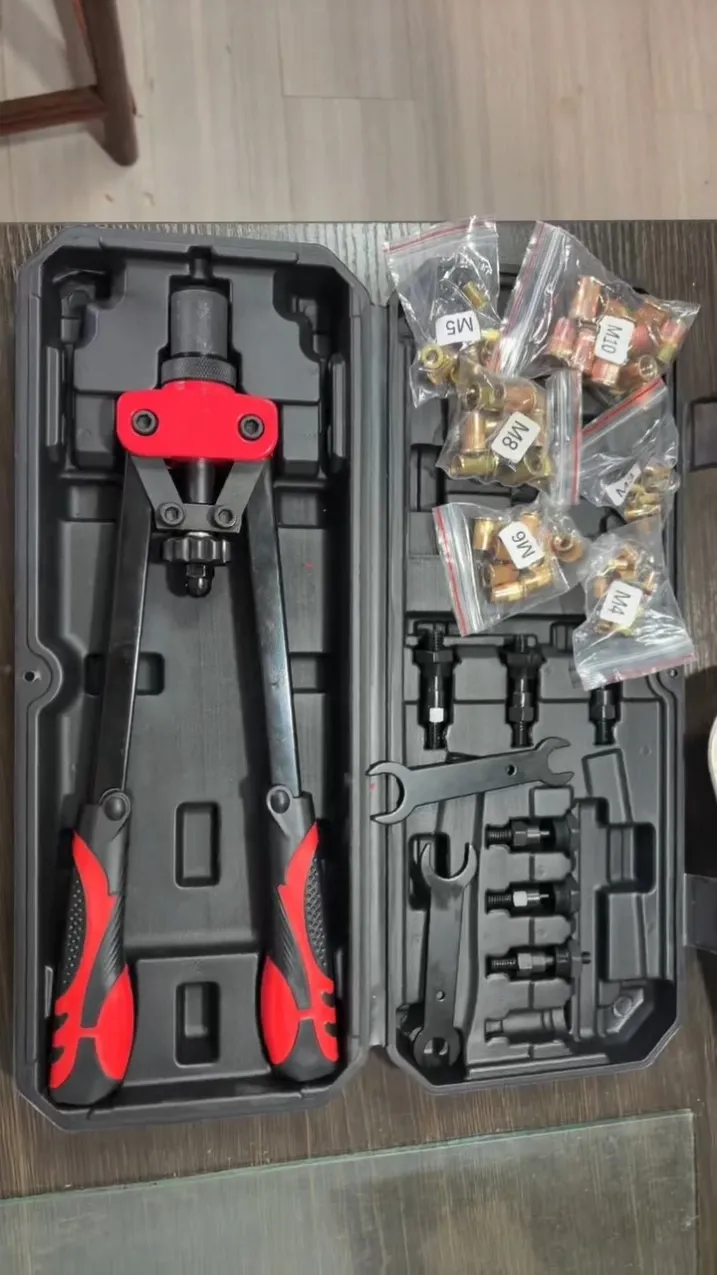
Fifty sets is five cartons. For the M3-M10 rivet nut gun kit we pack, ten sets go into one master carton, and small-batch customisation is available from 50 sets. That is the smallest quantity at which it makes sense to change the assortment, the printed materials or the carton marks for this configuration. It is not a blanket minimum for the whole catalogue: our 14-inch M3-M12 150-piece kit is separately listed at MOQ 500 sets, and every minimum is configuration-specific. This page sets out what can actually be changed at 50 sets, the carton arithmetic a freight quote depends on, the proofing order, and the things we will not promise at a small-batch quantity.
What "small batch" changes in a kit programme
A small batch is not a small version of a production order. It is a market test with customised packaging, which means the decisions that normally happen once a year now happen before the first carton is packed. The useful way to think about it is by carton, because the carton is the unit the forwarder quotes, the warehouse receives and the customs entry counts.
Order size | Cartons for this configuration | What it is good for | What must be confirmed in writing |
|---|---|---|---|
10 sets | 1 carton | A physical sample and a shelf test with the real case, sheet and insert labels | Whether the sample is the standard configuration or already carries buyer artwork |
50 sets | 5 cartons | First customised batch: assortment, bag labels, sheet language and carton marks | The current small-batch minimum for this exact configuration and packaging |
Larger programme | Quoted per configuration | Full OEM programme with wider thread range or a second tool family in one shipment | Model-specific minimum, artwork version, packing data and inspection records |
The middle row is the one buyers ask about most, because five cartons is small enough to test a market and large enough to justify a printed sheet. It is also the point where a mistake becomes expensive to repeat: if the bag labels are wrong, all five cartons carry the same wrong labels. That is why the proofing order below puts artwork approval before packing, not after it.
The customisation menu at 50 sets
Bag labels and mandrel layout in the standard kit. At 50 sets the bag labels, the language of the printed sheet and the carton marks are the three artwork items that can change; the mandrel list has to be decided together with the insert assortment, because a new bag size without its mandrel produces a kit that cannot set part of its own contents.
Customisation at this quantity is about what goes into and onto the kit, not about re-engineering the tool. The table separates the changes that are normally discussable from the ones that require a separate quotation. Where a change depends on tooling or on a document we do not hold, we say so rather than assuming it is included.
Item | What can be specified | What we do not assume |
|---|---|---|
Insert assortment | Which of the six labelled sizes (M3, M4, M5, M6, M8, M10) are packed, and the count per bag | That a different insert material, head style or grip range is covered at the same price |
Mandrel mix | Which matched mandrel/nosepiece pairs ship in the case | That sizes outside the printed parts list are available without a separate tooling discussion |
Bag labels | Printed size labels on each of the six insert bags | That unlabelled bulk inserts are acceptable for a retail kit |
Instruction sheet | Language or languages for the replacing, installing and working steps | That an existing translation is approved for your market without a proof |
Case and insert card | Label or printed insert card inside the blow-moulded case; case colour subject to confirmation | That a new case mould or a new cavity layout is included at the small-batch threshold |
Carton marks and barcode | Shipping marks, barcode placement and the carton marking schedule for the five cartons | That the barcode and carton marks match an artwork version that has not yet been approved |
Logo position | Where the buyer logo appears on the printed materials | That a logo moulded into the tool or a new certificate is part of the small batch |
Two lines in that table deserve emphasis. First, changing the insert assortment without changing the mandrel list produces a kit that cannot set part of its own contents; the two decisions have to be made together. Second, anything that requires new tooling, a new certificate or a third-party test report is quoted separately and is "available on request", not silently bundled into a 50-set price. If your market needs a specific document, name it before the quotation is issued so it can be priced and scheduled.
Carton arithmetic for a 50-set first order
Ten sets per master carton and a 50-set order give exactly five cartons. That single number drives four separate documents: the commercial invoice, the packing list, the carton marking schedule and the freight quotation. If one of them says five and another says fifty, the discrepancy is what a broker will query. Ask for carton dimensions, gross and net weight, and the carton marks in the same written packing data as the assortment, so all four documents are built from one source.
The four columns behind that arithmetic are explained in our carton and shipping data guide. It is written for a different product family, but pieces per carton, carton dimensions, gross weight and net weight are the same inputs a forwarder needs for a rivet nut kit. If a supplier cannot state them, a DDP quotation is an estimate rather than a price.
There is also a practical reason not to round the order up "to make the freight easier". Adding a sixth carton changes both the carton count and the allocation of destination charges, which means the per-set landed figure has to be recalculated rather than adjusted by a percentage. Five cartons is a clean unit for a first customised batch; keep it clean until the second order justifies a different assortment.
Proofing order: specification, artwork, sample, approval
Step one is the specification block: six mandrel sizes, insert count per bag, case layout, sheet languages and carton marks, written as lines rather than as a product name. Step two is the artwork proof for the bag labels, insert card and carton marks, with a dated version number. Step three is a representative sample built to that specification and that artwork, not a standard kit pulled from stock. Step four is the working check on the sample: thread one insert of each size, perform one changeover with the supplied wrenches, and close the case with every part inside.
Step five is written approval that names the artwork version and the sample date, and that approval is what the purchase order references. The detailed proofing sequence is set out in our private label packaging guide for hand tools; the field order transfers directly to a rivet nut kit. Inspection records belong in the same file, and our quality control process page describes the four gates worth specifying so the records exist before the cartons are loaded rather than being reconstructed afterwards.
A common shortcut is to approve the artwork but not the physical sample. That fails in a cased kit because the artwork is a physical item: a thicker multi-language leaflet or an extra insert card can stop the formed cavities from closing. Approve both, in the same batch, against the same version number.
What we do not promise on a 50-set order
We do not quote a fixed delivery date, a certification, a third-party test report, a new case mould or a bespoke tool design as part of a 50-set small batch. Those are quoted separately or are available on request, and they depend on the market and on the exact configuration. We also do not state that the 50-set threshold applies to other kits: minimums are model-specific, and the 14-inch M3-M12 150-piece kit is listed at MOQ 500 sets. Confirm the current minimum in writing for the configuration you are buying.
This is not caution for its own sake. A small batch is usually the first order a distributor uses to judge a supplier, and an optimistic promise made at that stage becomes the baseline for every later order. A written specification, a dated artwork proof and a named set of documents are more useful than a confident number that no one can evidence.
Getting the five cartons to you
Two delivery paths are available for this kit. FOB with delivery into your nominated consolidation warehouse in China (often called 进仓) suits buyers who already have a forwarder; DDP by courier, by air express or by sea, suits buyers who want one delivered price. Both are available for a five-carton order, and the right choice depends on deadline, carton weight, customs capability and how much control you want over the freight chain.
For the wider product family, the complete rivet nut tool type map places manual, pneumatic and battery setters against thread range, stroke and application; this kit-format sub-cluster sits under that Hub, so the range decision comes before the carton decision.
Our FOB versus DDP comparison for a 50-set kit order works through that decision against the five-carton packing data. For a mixed container with several tool families, the wider landed cost and documents guide gives a seven-line cost reconciliation that this single-SKU order does not need.
If you are still deciding whether a kit belongs in your first assortment at all, the six-decision buyer guide to importing hand tools places MOQ, assortment and shipping terms in one sequence, and the kit contents checklist gives the specification block to paste into the enquiry.
Frequently asked questions
What is the smallest customised batch for this kit?
Small-batch customisation for this M3-M10 kit configuration starts at 50 sets. That is five master cartons because ten sets fill one carton. Minimums are configuration-specific, so confirm the current figure in writing for the exact model and packaging before you plan the assortment.
How many kits are in a carton?
Ten sets per master carton for this configuration. Ask for carton dimensions, gross and net weight and the carton marks in the written packing data; those are the figures a forwarder quotes against and the figures that must agree across the invoice, packing list and carton schedule.
What can actually be customised at 50 sets?
The insert assortment within the six printed sizes, the mandrel mix that matches it, the printed size labels on the bags, the instruction sheet language, the case label or insert card (case colour subject to confirmation), the carton marks and barcode, and the logo position on printed materials. Changes needing new tooling or new documents are quoted separately.
Can I get a custom case mould or a new certificate?
Not as an assumed part of a 50-set batch. New tooling, certifications and third-party test reports are quoted separately or are available on request. Name the document or the tooling change in the enquiry so it can be priced and scheduled before the artwork is approved.
Do I need to approve a sample if the kit is already standard?
Yes, if anything is customised. A standard kit from stock does not prove that the bag labels, sheet language and insert card in your five cartons are correct. Approve a representative sample built to the dated artwork version, and reference that approval in the purchase order.
Can FOB and DDP both be used for five cartons?
Yes. FOB with delivery into your China consolidation warehouse and DDP by air express or sea are both available for this order size. Ask for both quotations against the same five-carton packing data so the comparison is between delivery terms rather than between two different assortments.
Does the 50-set minimum apply to the 150-piece kit?
No. That kit is listed separately at MOQ 500 sets. Treat every minimum as configuration-specific and ask for the current figure in writing; carrying a number from one kit to another is the most common way a first order gets mispriced.
Send the six thread sizes, the insert assortment, the sheet languages, the artwork version and the destination, and request a written quotation for a 50-set batch. We will confirm the current minimum, carton data and delivery options for the exact configuration in one reply.
Next step: put this into an RFQ
Put the selection above into an enquiry: list the item numbers or capacity bands you need, the quantities you are planning, any packaging or artwork requirements, and your destination port. Our team will confirm specification details and order terms per order. Send it through the request a quotation page; if you are still choosing between models, include the cable, tube or terminal sizes you work with so the range can be checked before sampling.
For the full range, see the rivet nut tools category covering manual and pneumatic tools, kit contents, thread sizes and carton data for distributors.