FOB or DDP for a 50-Set Rivet Nut Kit Order?
Five cartons of ten kits can move FOB into your China consolidation warehouse, or DDP by air express or sea. Here is the decision matrix and the lines a quotation must state in writing.
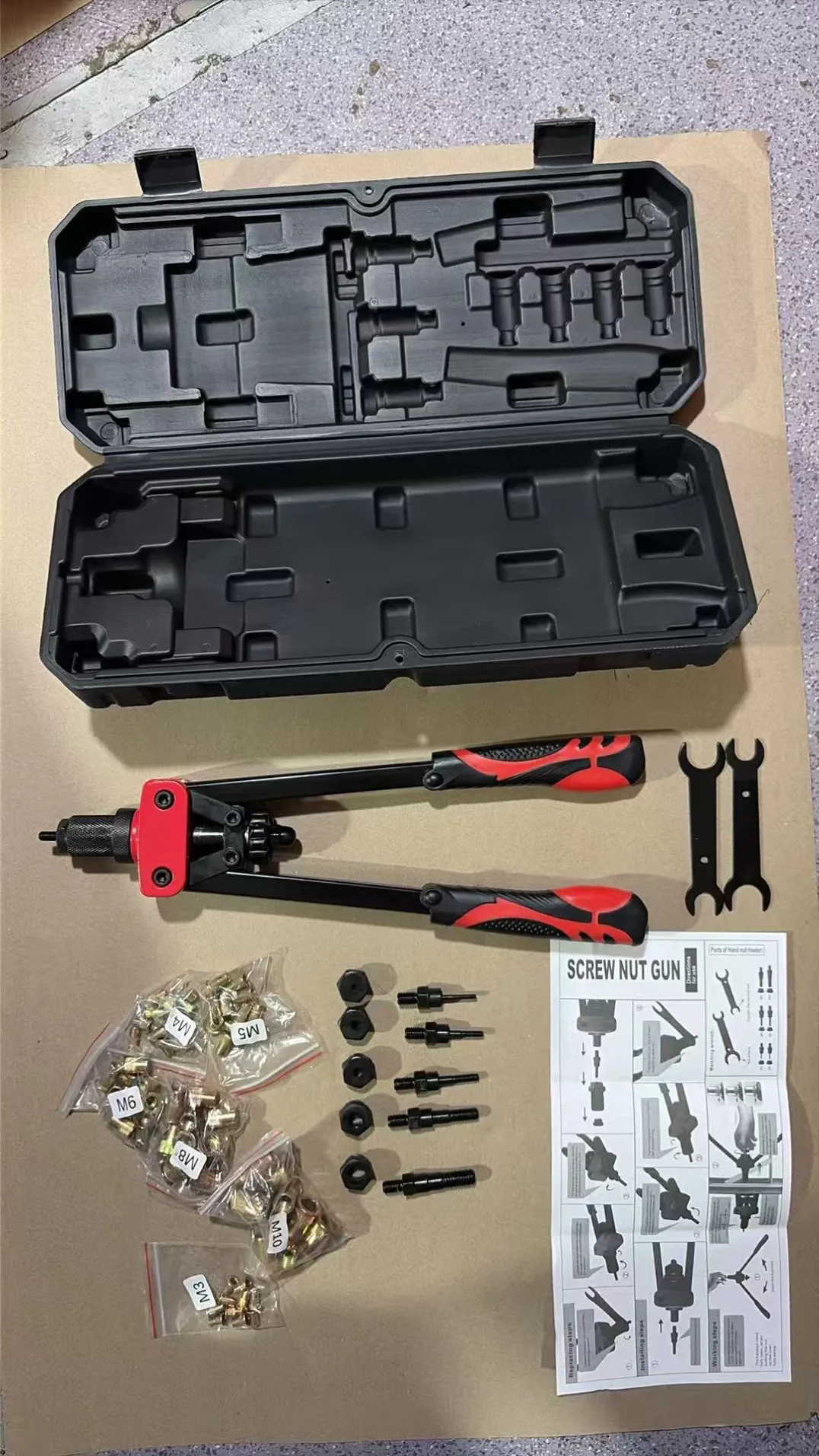
Five cartons is an awkward shipment size. For the M3-M10 rivet nut gun kit we pack, ten sets fill one master carton, so a 50-set first customised batch is exactly five cartons: too small for a buyer to command a full container, too heavy for a parcel to be cheap by air, and too early in the relationship to assume the buyer already has a broker in place. Both delivery paths are available: FOB with the cartons delivered into your nominated consolidation warehouse in China (often called 进仓), or DDP by courier by air express or by sea. This page gives a decision matrix for those five cartons, explains what each term actually commits the two parties to, and lists the four mismatch lines that hold a small order at customs.
Two paths for the same five cartons
One M3-M10 kit in its blow-moulded case. Ten of these kits fill one master carton, so the 50-set first customised batch on this page is exactly five cartons. That single packing figure has to appear on the commercial invoice, the packing list, the carton marking schedule and the freight quotation, which is why it belongs in the RFQ before either delivery term is priced.
The product does not change with the delivery term; the packing data does not change either. What changes is who books the freight, who files the entry, who pays the destination charges and who can see the real numbers. Read the table as a division of work, not as a price comparison.
Path | What the seller does | What the buyer does | Where it fits |
|---|---|---|---|
FOB with warehouse delivery (进仓) | Packs the five cartons and delivers them to the buyer-nominated warehouse or consolidation point in China | Nominates the forwarder, arranges export onward, destination clearance and last mile | The buyer already imports regularly or is consolidating this kit with other tool families |
DDP by air express | Arranges the courier chain through to the delivery address, with the agreed duty and tax scope in writing | Receives the cartons at the named address and checks them against the packing list | A first order with a deadline, or a buyer without a customs setup in the destination market |
DDP by sea | Arranges the sea leg, destination handling and delivery through to the named address | Confirms the delivery address, access and any unloading requirements | A first order where cost per carton matters more than speed and the destination has a workable LCL service |
Note that 进仓 is a physical instruction about where the cartons are handed over, not an Incoterm on its own. If the handover happens at a domestic warehouse rather than on board a vessel, the arrangement is technically closer to FCA than to FOB. That distinction is not pedantry: it decides who pays the inland leg and who files the export declaration. Write the named place and the split of responsibilities into the purchase order so the two parties are not relying on different readings of three letters.
A decision matrix for a five-carton order
Seven questions settle most first-order delivery choices. The last column turns each into a line the RFQ must contain; a quotation that leaves one of those lines blank cannot be compared with an alternative quotation, because the missing cost has not disappeared, it has simply moved to the buyer.
Criterion | FOB with 进仓 | DDP air express | DDP sea | What to write in the RFQ |
|---|---|---|---|---|
Deadline | Buyer controls the schedule after the warehouse handover | Fastest of the three options | Slowest of the three options | Required delivery date and whether a partial air shipment is acceptable |
Carton count and weight | Five cartons; buyer forwarder consolidates | Chargeable weight can dominate the quote | LCL minimums and destination charges matter | Five cartons, dimensions and gross/net weight per carton |
Customs capability | Buyer needs a broker and an import setup | Seller arranges the agreed clearance scope | Seller arranges the agreed clearance scope | Who is importer of record and who files the entry |
Cost visibility | Freight, duty and destination charges appear as separate lines | Usually one all-in figure | Usually one all-in figure | A breakdown of freight, duty/tax, destination charges and last mile |
Inspection access | Easiest to arrange a check before the goods leave the consolidation point | Harder to insert an independent check in the courier chain | Possible but needs to be scheduled before loading | Whether a pre-shipment check is required and who pays for it |
Last mile | Buyer arranges delivery from the destination | Usually included if the quotation says so | Often quoted to a port or depot rather than a door | The exact delivery address and whether unloading is included |
Insurance and risk | Buyer decides cover after the handover point | State who covers loss in transit | State who covers loss in transit | Named insurance scope and the point where risk transfers |
The matrix is deliberately written for one SKU and one carton count. A mixed container with several tool families needs a different calculation, because freight and destination charges then have to be allocated across SKUs by volume and weight rather than by invoice value. Our landed cost and documents guide explains the seven-line reconciliation for that case; this page is the smaller, earlier decision that comes before a consolidated load exists.
What FOB with warehouse delivery actually means
Under a conventional FOB Ningbo quotation the seller is responsible for getting the goods through export clearance and onto the vessel named by the buyer; risk and cost then pass to the buyer. When the buyer instead asks for delivery into a nominated consolidation warehouse (进仓), the physical handover happens earlier and inland, usually because the forwarder is assembling goods from several suppliers. The written order therefore has to say four things explicitly: the named place, who pays the inland leg to that place, who files the export declaration afterwards, and at what point risk transfers. Without those four lines, an unexpectedly high trucking or terminal charge becomes an argument rather than a line item.
The practical advantage is consolidation. A distributor already buying flaring kits or drain augers can put five cartons of rivet nut kits into the same load and keep one bill of lading and one customs entry. The practical cost is that the buyer now owns the schedule: if the forwarder misses a cut-off, the seller has already delivered to the warehouse as agreed. Buyers new to importing often underestimate that difference because the quotation looks cheaper than a delivered price.
The commercial questions that usually sit next to this decision are collected in our hand tool sourcing FAQ on catalogues, samples, payment and importing, including how to obtain a catalogue, whether a factory visit is possible and which payment methods are used. Bringing those answers into the same written thread as the Incoterm avoids approving the goods and the delivery terms in two different conversations.
What a DDP quotation must state in writing
DDP is attractive on a five-carton order because it removes several parties from the buyer's task list. It is also the term most often quoted too loosely. Before comparing a DDP figure with an FOB figure, require the following lines in writing: the exact delivery address and whether it includes unloading; who is the importer of record; which duties and taxes are covered and which are excluded; whether last-mile delivery is included or stops at a depot; the insurance scope; the HS code used for the kit; and what happens if customs holds or inspects the cartons. A single all-in number without those lines is not comparable with a line-item FOB quotation.
Ask also for the same five-carton packing data under both quotations. A DDP price built on an estimated carton weight and an FOB price built on the real one are not two prices for the same service. Where a supplier quotes DDP, the duty and destination lines move into the seller price; the comparison still works, but the rows have to be relabelled before the two numbers mean anything.
The carton and shipping data guide lists the four columns every freight quote depends on: pieces per carton, carton dimensions, gross weight and net weight. Although it uses an oil can as the worked example, those columns are identical for a rivet nut kit, and a supplier who cannot state them is quoting a guess.
Air express or sea for five cartons
Both DDP air express and DDP sea are available for this kit, so the choice is not about availability but about which cost you are willing to pay for time. Air express gives the shorter chain and suits a launch date, a trade show or a sample rollout; chargeable weight rather than actual weight usually decides the invoice, and a cased tool kit is a bulky item relative to its mass. Sea gives a lower cost per carton but introduces LCL minimums, destination handling and a longer, less flexible schedule. For five cartons, the fixed charges at destination can matter more than the ocean freight itself.
A useful way to decide is to ask for both quotations against the same packing data, then compare the difference in delivered cost against the cost of missing the date. Do not ask for an estimated transit time and then treat it as a commitment: transit estimates are forwarder information, and the written order should state what was actually promised. If the deadline is real, put it in the RFQ before the quotation is issued.
Four mismatch lines that hold a small order
A five-carton order does not fail because it is small; it fails because the same five cartons are described differently on four documents. The table names the four lines we check before a first shipment leaves, the document that evidences each, and the fix. None of them requires a freight expert, only a single source of packing data.
Mismatch line | Where it appears | What goes wrong | Fix before booking |
|---|---|---|---|
Carton count | Commercial invoice, packing list, carton marking schedule | One document says five cartons and another says fifty sets without the 10-per-carton conversion | State "5 cartons / 10 sets per carton / 50 sets" on all three |
Gross and net weight | Packing list, courier or bill of lading | Chargeable weight is estimated, so an air quote is revised after collection | Use the written carton weight, not an estimate |
HS code and product description | Customs entry and commercial invoice | Several tool families are collapsed into one code, or the kit is described as a bare tool | Use one item-level description for the cased kit and confirm the code for the destination |
Consignee and delivery address | Bill of lading / courier waybill, arrival notice | DDP goods are consigned to a depot while the buyer expects a door delivery | Name the exact delivery address and the importer of record in the quotation |
Inspection records belong in the same file. Our quality control process page describes the four gates worth naming in the RFQ so the records are produced as part of the order instead of being reconstructed after loading. For the wider view of how this single-SKU shipment fits into a first import, see the six-decision buyer guide to importing hand tools.
Where to go next
The 50-set small-batch customisation page gives the carton arithmetic behind the five cartons, and the kit contents checklist gives the six-line specification that should be fixed before either delivery term is quoted. The complete rivet nut tool type map is the Hub for the product family if you are still deciding which configuration belongs in the range.
Frequently asked questions
Is FOB or DDP better for a 50-set first order?
Neither in the abstract. FOB with 进仓 suits a buyer who already has a forwarder or is consolidating with other tool families; DDP suits a buyer who wants one delivered price and either a firm deadline or no customs setup. Ask for both against the same five-carton packing data and compare the written scope, not the headline number.
What does FOB with 进仓 mean?
The seller delivers the cartons to your nominated consolidation warehouse in China, and your forwarder takes over from there. Because the handover is inland rather than on board a vessel, name the place and state explicitly who pays the inland leg, who files the export declaration and where risk transfers.
Can DDP be shipped by sea as well as by air?
Yes. DDP by courier is available by air express and by sea for this kit. Air suits a deadline; sea usually lowers the cost per carton but adds LCL minimums, destination handling and a less flexible schedule. Ask for both quotations against identical carton dimensions and weights.
What must a DDP quotation include?
The exact delivery address and whether unloading is included, the importer of record, which duties and taxes are covered and excluded, the insurance scope, the HS code, the last-mile arrangement, and what happens if the shipment is held for inspection. Without those lines an all-in DDP figure cannot be compared with a line-item FOB quotation.
Why do five cartons get held at customs?
Most often because the carton count, weight, description or consignee differs between the invoice, packing list and transport document. State "5 cartons / 10 sets per carton / 50 sets" consistently, use the written carton weight, and make sure the DDP consignee matches the delivery address you actually expect.
Do I need a freight forwarder for FOB?
Effectively yes. Under FOB with warehouse delivery the buyer nominates the forwarder and arranges export onward, destination clearance and last mile. If you do not have that setup, a DDP quotation is usually the simpler first-order path, provided its scope is written out line by line.
Does this five-carton calculation apply to a mixed container?
No. A mixed container has several SKUs and several HS codes, so freight and destination charges have to be allocated across the assortment by volume, weight and carton count. Use the seven-line landed cost reconciliation for that case rather than the single-SKU decision matrix on this page.
Send the quantity, the destination, whether you have a nominated forwarder and the delivery date you need, and request a written FOB and DDP comparison. We will quote both against the same confirmed five-carton packing data for the exact kit configuration.
For the full range, see the rivet nut tools category covering manual and pneumatic tools, kit contents, thread sizes and carton data for distributors.