Terminal Types Guide: Spade, Ring, Disconnect, Butt Splice and Ferrule
A buyer's guide to spade, ring, disconnect, butt-splice and ferrule terminals: which crimp terminal to stock, how to match wire size, and what to confirm before ordering a terminal crimping kit.
Why the terminal type matters more than the tool
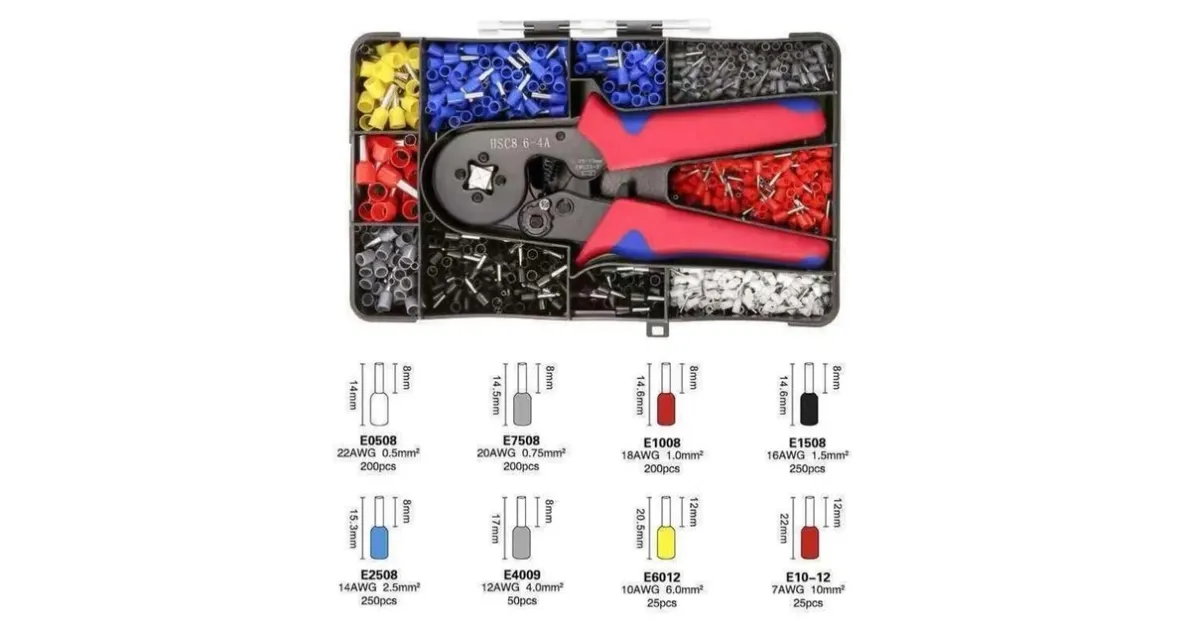
Buyers often start with the crimping tool, but the terminal type decides whether the connection is right for the job. A general wiring kit usually combines insulated terminals — spade, ring, disconnect, butt splice — with a wire-end ferrule for screw-clamp blocks. Knowing which ones your customers actually use makes it easier to specify a kit that sells.
Spade and ring terminals
Spade (fork) terminals slide under a screw and are used where the connection may be loosened for service, such as terminal strips and automotive panels. Ring terminals close completely around the stud, so they cannot slip off and are preferred where vibration is present. In the reference kit these are supplied in two wire-size groups, identified by the red and blue insulation.
Disconnect and butt-splice terminals
Male and female disconnects form a push-on connector that can be separated without cutting the wire — common in appliances, automotive harnesses and control cabinets. Butt splices join two wires end to end in a single crimp, used for extensions and repairs. Both are supplied as insulated barrels sized to a specific conductor range.
Cord-end ferrules
A ferrule is a small metal sleeve crimped onto the stripped end of a stranded conductor. It holds the strands together so the wire enters a screw-clamp terminal cleanly and no stray strands break off. Ferrules are standard in control panels, terminal blocks and switchgear.
Matching the terminal to the wire size
Insulated terminals are colour-coded by conductor size, but the colour system is not identical across manufacturers. Always match by the part number and the printed wire range, not by colour alone.
Terminal | Naming example | What the code tells you |
|---|---|---|
Spade / ring | SV1.25-3 / RV2-3.5 | Conductor size and stud or fork width |
Disconnect | FDD1.25-250 / MDD1.25-250 | Conductor size and tab width |
Butt splice | BV1.25 | Conductor size |
Cord-end ferrule | EN1501 | Ferrule series / size marking |
Confirm the marking on the goods you receive, because naming conventions differ between suppliers.
What to confirm in a terminal kit order
- The terminal types you want in the box and the quantity of each.
- The wire-size range marked on each terminal and the crimping range of the tool.
- Whether the tool is supplied alone or with the full terminal assortment.
- Logo placement and packaging if you are ordering private label.
Related guides
See the multi-function wire stripper and crimper kit for the full contents table, and read the kit selection guide to choose the right tool configuration.